
Modern dealmaking is facing a new kind of tension.
Internally, deal teams are under pressure to research faster and scale more efficiently. Externally, clients demand trust, security, data privacy, and profitability.
To explore how purpose-built AI solutions are relieving this tension across the deal lifecycle, Ansarada brought together investment bankers and private equity professionals for an insight-packed AI Breakfast Club event in Sydney, Australia.
The primary discussion was led by Justin Smith, Managing Director at Ansarada, and Henry Lindemann, Co-Founder and Chief Growth Officer at Blueflame AI.
Here’s what stood out.
Three takeaways on AI in modern dealmaking
1. AI models shouldn’t have to sacrifice security for speed
Ansarada has spent 20 years building credibility across 170 countries, and as Justin Smith reinforced, that trust cannot be compromised for productivity gains.
Yet, the pressure to deliver faster research and tighter workflows is relentless.
“We don't want to trade all that [credibility] for innovation. That's why we've treaded this road carefully,” said Smith.
The Blueflame AI and Ansarada partnership is designed around this balance. Enterprise-grade security and data privacy are foundational — where data isn’t retained, models can't learn from your data, and regulated teams can operate safely from day one.
2. Past technology trends can offer a glimpse into future AI patterns
The current AI wave in dealmaking echoes patterns Henry Lindemann and Blueflame AI Co-founder, Raj Bakhru, have seen twice before: the rise of capital markets technology and institutional cybersecurity.
In both cases, the largest investment firms initially built proprietary technology systems. However, over time, even the biggest players migrated to scalable, third-party solutions — leaving only the firms with strong engineering teams to build in-house.
AI is following the same trajectory. “The ChatGPT epiphany spread, and everybody knew they needed access to [AI], but they didn't know how,” Lindemann explained.
Today, foundation models alone aren’t a competitive edge; they’re table stakes.
The real advantage comes from purpose-built AI that automates the 80% of tasks common across investment firms, freeing deal teams to focus on the 20% that defines their unique approach — fiduciary judgment, relationship nuance, and years of pattern recognition.
3. AI is transforming the junior banker role for the better
The most immediate impact of AI on dealmaking is the shift in how content is created and who spends time on what.
Lindemann emphasized the most significant change: the junior banker role.
Content generation, including pitch books, IC memos, and investor presentations, can now be produced faster and with greater consistency.
This frees up junior team members in investment banking to spend more time where it matters — working alongside senior bankers to pressure-test ideas, refine positioning, and debate the merits of a deal.
The dynamic is shifting for senior bankers, too. They aren’t writing as many prompts as they once were, and increasingly, they don’t need to.
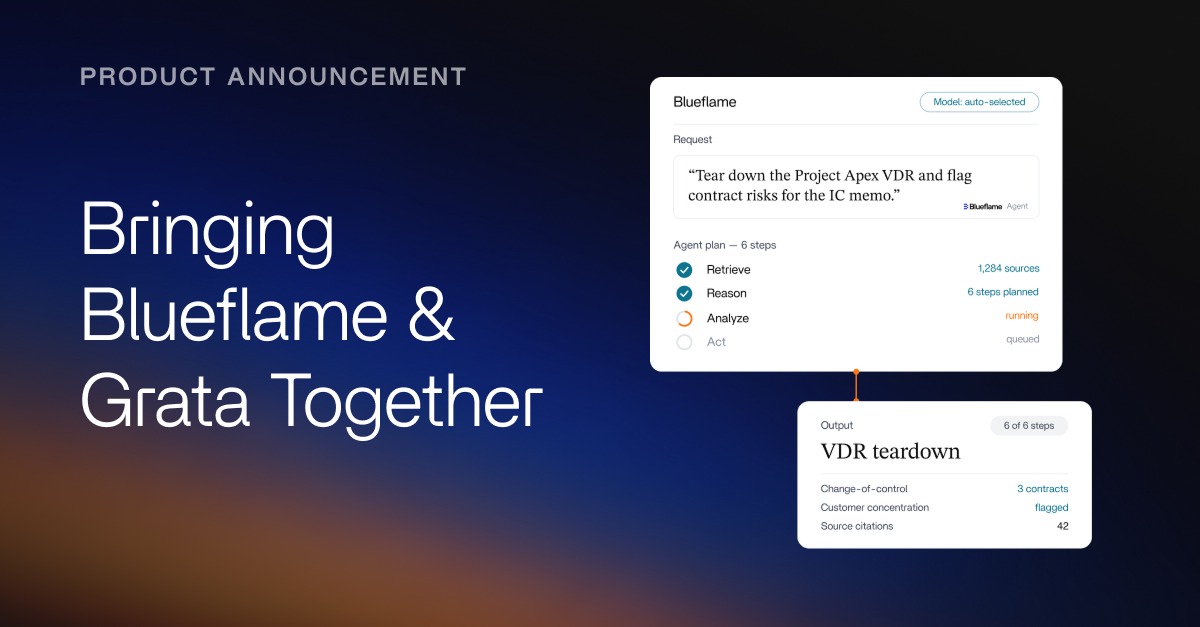
Platforms like Blueflame AI now serve as intelligent deal workspaces, surfacing real-time visibility into pipeline activity, team performance, and deal progress.
For example, senior bankers can now deliver information in a format that resembles a Bloomberg terminal, allowing them to spend higher-quality time targeting parts of the business or parts of the deal where they could be moving the needle.
Purpose-built AI for modern dealmaking
To make a sustainable impact across the deal lifecycle, dealmakers and investment firms are leveraging purpose-built AI equipped with the right customization, enterprise-grade security, and handoff points between machine output and human judgment.
Request a demo to see how Blueflame AI's intelligent deal workspace can transform the way you work.