
There comes a moment with every transformative technology when the question shifts from “Should we explore this?” to “Can we afford not to?”
For private equity firms considering AI, that moment is now.
Portfolio monitoring has long been treated as a reporting exercise: quarterly updates, spreadsheets, board decks, and hours of manual analysis.
Insights emerge eventually, but often too late to act.
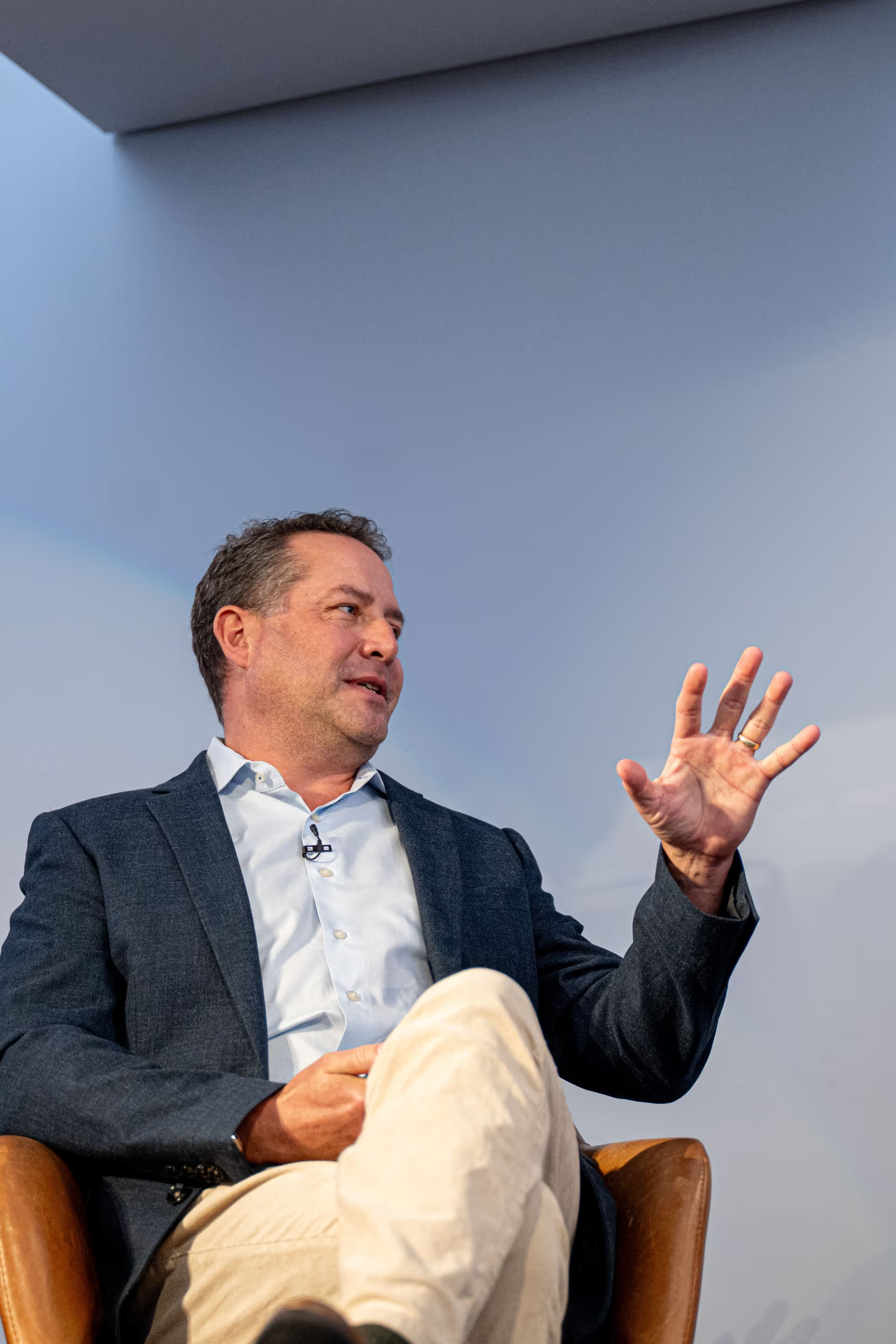
I recently led a panel at the Private Equity Wire European Summit, demonstrating how AI is fundamentally changing this model.
Leading firms aren’t just automating existing processes; they are redefining how they source and evaluate opportunities, manage portfolio companies, and manage relationships with limited partners (LPs).
The result? A widening gap between firms that have successfully operationalized AI and those still running pilots.
Why traditional portfolio monitoring no longer works
For decades, portfolio monitoring has operated on a simple premise: collect information, review it carefully, and escalate problems. That model worked when portfolios were smaller, reporting cycles were predictable, and risk factors evolved slowly.
Today, investment firms manage larger, more complex portfolios with data from dozens of sources — financial statements, lender reports, emails, operational updates, and board materials.
Much of this data is unstructured, inconsistent, and arrives asynchronously.
In other words, manual analysis can’t keep up.
“[AI] is no longer optional. It’s not an IT project like an SAP implementation that might go wrong — it’s something you must get right because someone else will. However, AI is only about 20% of the solution. The rest is adoption and changing how the business operates.” — Mittu Sridhara, Managing Director of Digital & Technology, Europe at Clayton, Dubilier & Rice

Five ways AI is transforming portfolio monitoring
So, how are investment firms putting AI to work in private markets?
Let’s look at five areas where AI is transforming portfolio monitoring.
1. From data chaos to actionable insights in minutes
One of the biggest bottlenecks I see in portfolio monitoring is preparing data for analysis.
Reports, board decks, legal amendments, and financial statements arrive in PDFs, slides, and spreadsheets with inconsistent formatting.
With agentic content creation capabilities, documents that once took hours to sort through become actionable data.
Blueflame AI’s agentic content creation tools, powered by Claude, OpenAI, and Gemini, are a major expansion of our embedded, “last-mile” content generation across Microsoft Excel, PowerPoint, and Word.
Users can quickly produce professional-grade slide decks, spreadsheets, and documents formatted specifically for financial services use cases, all within a single, agentic workflow.
Investment firms gain:
- Faster ingestion of reporting materials
- Reduced manual reconciliation
- Consistent analysis across the portfolio
2. Continuous portfolio monitoring that never misses a signal
AI enables always-on portfolio awareness, continuously tracking changes across financial metrics, governance updates, and external signals.
Investment firms can now spot:
- Variances in financial performance as new data arrives
- Changes to covenant language or legal agreements
- Delays or irregularities in reporting behavior
- Leadership or governance shifts within portfolio companies
Instead of static snapshots, firms get a living picture of portfolio health.
3. Identifying early warnings signs
Historically, portfolio monitoring flagged problems only after they became visible. By then, underlying issues had often been developing for months.
I’ve seen first-hand that AI excels at pattern recognition across large datasets, surfacing subtle signals that might go unnoticed individually but are meaningful in combination:
- Gradual margin compression inconsistent with management narratives
- Shifts in working capital behavior
- Reporting delays or inconsistencies
- Changes in language across disclosures, board materials, or updates
“Deal materials are always prettied up to tell the best story. [Blueflame AI] built workflows where AI acts as a devil’s advocate to spot yellow and red flags. But technology alone isn’t enough — success requires agility, continuous adaptation, and the thoughtful integration of tools.” — Justin Guthrie, COO, Blueflame AI
4. Searchable institutional memory
Portfolio monitoring has traditionally relied on individual experience. For example, a senior investor recognizes patterns because they’ve seen them before.
AI adds a new layer with the ability to query historical portfolio data at scale.
Teams can quickly answer questions such as:
- “Have similar covenant adjustments preceded credit deterioration?”
- “What happened when reporting delays increased historically?”
- “How did comparable companies respond to cost pressures?”
This creates institutional memory, enabling faster decisions and stronger investment committee discussions.
5. Portfolio monitoring as a strategic value-creation tool
Portfolio monitoring has been viewed as a defensive discipline — a way to detect risk and prevent losses.
However, when portfolio monitoring systems continuously analyze operational and financial data across a portfolio, they begin to surface not only risks, but opportunities.
Patterns that appear across companies can reveal:
- Identify underutilized pricing power
- Spot shared cost inefficiencies
- Detect cross-sell or upsell potential
- Reveal operational bottlenecks management may not recognize
Monitoring becomes an engine for value creation, improving performance while protecting capital.
Frequently asked questions about AI-powered portfolio monitoring
What is continuous portfolio intelligence and how does it differ from traditional monitoring?
Continuous portfolio intelligence uses AI to analyze portfolio data in real-time, providing ongoing insights rather than periodic snapshots. Unlike traditional quarterly or monthly reviews, purpose-built AI systems like Blueflame AI continuously process financial statements, board materials, and operational updates as they arrive, enabling immediate detection of trends, risks, and opportunities.
How quickly can AI process unstructured portfolio documents compared to manual analysis?
Blueflame AI can convert PDFs, board decks, and financial statements into actionable insights within minutes, compared to hours or days required for manual processing. The platform is designed to extract, reconcile, and normalize data from inconsistent formats across multiple sources.
Can AI portfolio monitoring integrate with existing investment management systems?
Yes, Blueflame AI is designed to integrate with existing data sources and systems of record. Blueflame AI processes information from financial statements, lender reports, emails, operational updates, and board materials regardless of format.
Bring AI-driven intelligence to portfolio monitoring
The evolution from reactive portfolio monitoring to continuous, AI-driven intelligence is happening now, and the winners are already emerging.
Investment firms that embrace AI aren’t just automating old processes; they are transforming how value is identified, risks are mitigated, and opportunities are realized.
Request a demo to discover how Blueflame AI’s workflows can transform your portfolio monitoring, from quarterly snapshots to ongoing intelligence that drives better investment decisions.