When MIT Sloan Management Review published its 2025 The GenAI Divide report, it found that despite billions invested in generative AI, only 5% of organizations reported achieving measurable return on investment (ROI).
While AI technology has advanced rapidly since then, the report's central finding — that operationalizing AI is far more difficult than adopting it — continues to resonate across the investment industry.
For investment firms, this raises an important question: What separates organizations that successfully operationalize AI from those stuck in pilot mode?
In this article, we revisit MIT's findings, compare them with what we're seeing across investment firms today, share practical strategies for achieving measurable AI ROI, and include an AI ROI readiness checklist to help benchmark where your firm stands today.
AI ROI statistics from MIT's 2025 report
The MIT Sloan Management Review report, The GenAI Divide: State of AI in Business 2025, highlights the growing gap between AI investment and business outcomes:
Why investment firms struggle to achieve AI ROI
While MIT identified several causes of AI underperformance, our experience working with private equity, venture capital, and asset management firms suggests that AI initiatives typically stall for five recurring reasons.
1. Unclear business priorities
Many firms begin with broad ambitions to "implement AI" rather than identifying the specific workflows they want to improve. As a result, they often launch multiple AI pilots but struggle to operationalize them across the organization.
Without clear business objectives, governance, and a rollout strategy, these proof-of-concepts can lead to pilot fatigue, making it difficult to prioritize investments, measure success, or demonstrate ROI.
The most successful implementations start with targeted, high-value use cases — such as CIM analysis, due diligence, deal sourcing, or investor reporting —and establish measurable outcomes from the outset. By proving value in a few critical workflows first, firms can build momentum, drive adoption, and confidently expand AI across the organization.
2. AI exists outside the workflow
One of the biggest barriers to AI adoption isn't the model itself — it's how AI is deployed across the organization.
LLM providers aim to outpace each other weekly. That’s why model performance is becoming less of a competitive differentiator.
The bigger challenge is managing how individuals experiment with their own AI workflows.
While standalone AI assistants can make one professional more productive, they often create fragmented processes, inconsistent outputs, and knowledge that remains trapped with individual users.
For investment firms, the real opportunity is building institutional intelligence: embedding AI into the workflows where teams source deals, conduct due diligence, prepare investment materials, and communicate with investors. When AI is connected to firm data, enterprise systems, and shared processes, organizations can scale expertise, improve consistency, and create measurable business value across the entire firm.
3. General-purpose AI can't support specialized investment work
Foundation AI models are powerful for brainstorming, summarizing information, and answering questions. However, investment professionals need AI that can do more than generate responses — they need AI that can operate within the firm's workflows.
The limitation isn't the intelligence of today's AI models. It's that intelligence alone isn't infrastructure.
While an LLM can answer a question, it cannot independently execute work across enterprise data, systems, permissions, and business processes. Without the orchestration layer that connects those elements, AI remains a standalone tool rather than an operational capability.
Purpose-built AI platforms bridge that gap by connecting firm knowledge, enterprise systems, and finance-specific workflows.
This allows AI to support complex tasks like due diligence, CIM analysis, deal sourcing, investor reporting, and portfolio monitoring while operating within the governance, security, and compliance standards expected by institutional investors.
4. Adoption is treated as an afterthought
AI implementation doesn't end when the technology is deployed. Successful firms recognize that achieving ROI requires ongoing workflow refinement, user training, executive sponsorship, and continuous adoption — not just a one-time software rollout.
That's why many investment firms choose to work with a technology partner that continues to optimize workflows, incorporate user feedback, and support adoption as business needs evolve.
By treating AI as an ongoing operational capability rather than a one-time implementation, organizations can improve consistency, increase adoption, and maximize the long-term value of their AI investments.
The evolution from foundation AI models to purpose-built AI
One of the clearest themes emerging from MIT's research is that organizations achieve stronger returns when AI becomes embedded into everyday work rather than existing as a standalone productivity tool.
Across private equity, that evolution is increasingly taking the form of AI agents.
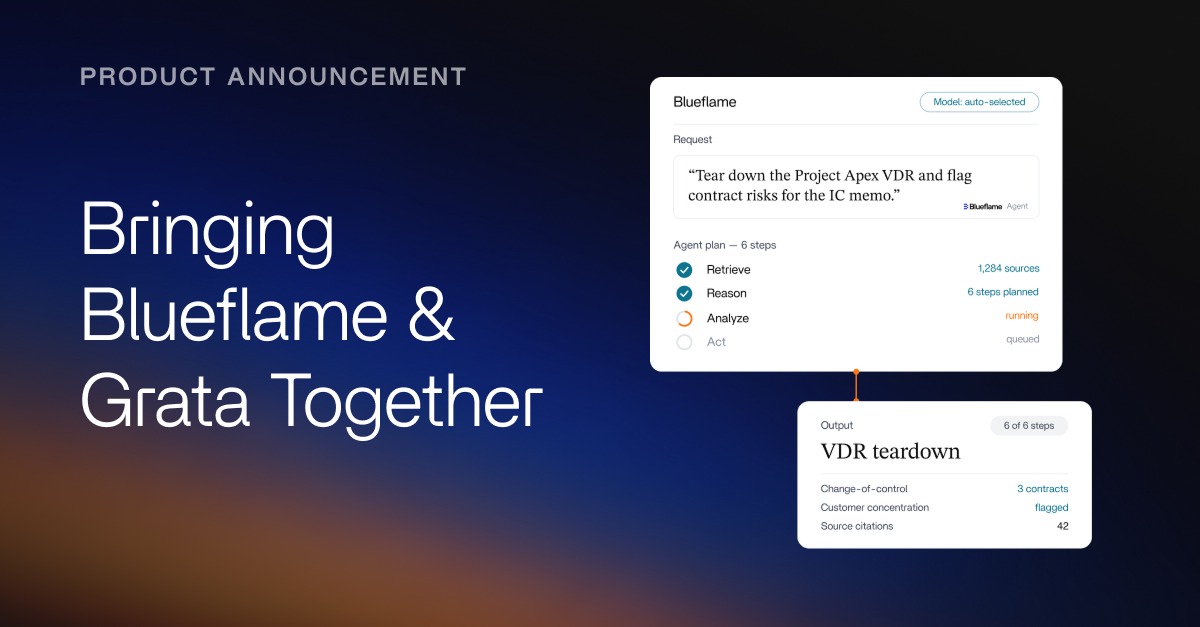
Unlike traditional AI assistants that respond to individual prompts, AI agents can orchestrate multiple tasks, connect to enterprise data, and support multi-step workflows while keeping professionals in control of decision-making.
Blueflame AI’s specialized AI agent, Amp, was built around this approach.
Amp combines firm knowledge, finance-specific skills, enterprise integrations, and leading AI models to help investment teams complete complex workflows, including CIM analysis, due diligence, deal sourcing, investor reporting, and meeting preparation, without constantly switching between applications or rebuilding context.
For firms looking to move beyond experimentation, AI agents represent the next stage of AI adoption: not simply ge
Measuring AI ROI requires more than time savings
While time savings are often the first indicator of AI value, organizations achieving long-term ROI measure far more than productivity gains. They establish baseline metrics, track workflow adoption, evaluate improvements in decision quality, and connect operational improvements to measurable business outcomes.
We've put together a comprehensive guide that walks through the complete AI ROI measurement framework, including KPIs, benchmarking guidance, and an AI ROI readiness checklist for investment firms and dealmakers.
Read: How to Measure AI ROI: KPIs, Framework & Checklist.
Frequently asked questions on AI ROI
Why do most AI projects fail to generate ROI?
Many AI initiatives fail because they lack clear business objectives, remain stuck in pilot phases, fail to integrate into existing workflows, or rely on generic tools that do not support industry-specific processes.
What AI use cases generate the highest ROI in private equity?
High-performing use cases often include CIM analysis, deal sourcing, due diligence, investor reporting, portfolio monitoring, meeting intelligence, and transcript analysis.
Why are AI agents becoming important?
AI agents go beyond answering questions by coordinating tasks, connecting enterprise data, and supporting multi-step workflows. For investment firms, this helps reduce manual work while embedding AI more naturally into existing processes.
Should investment firms use general-purpose AI or purpose-built AI?
General-purpose AI can improve personal productivity, but firms often realize greater operational value from purpose-built AI platforms designed specifically for investment workflows, data security requirements, and industry terminology.
Closing the AI ROI gap
MIT's findings reinforce an important lesson for enterprise leaders: AI success isn't determined by how much organizations spend — it depends on how effectively AI is integrated into high-value business workflows.
To close the AI ROI gap, we recommend investment firms:
- Create an AI strategy committee. Establish governance and accountability for AI programs, ensuring priorities are aligned across teams.
- Develop an AI roadmap. Start with three to five high-value use cases, deliver measurable results, and expand in phases.
- Define and measure success. Track both efficiency gains (hours saved, timelines shortened) and quality improvements (better decision-making, stronger reporting).
- Prioritize integration. Ensure AI connects seamlessly to your existing data and systems — CRMs, data providers, and file storage — to minimize disruption and maximize adoption.
- Choose a trusted technology partner. Look for an AI provider who combines credibility, domain expertise, and security into a purpose-built solution that can support long-term adoption.
As AI continues to evolve, we're also seeing a shift from traditional AI assistants to AI agents capable of coordinating deal work across investment workflows.
Investment firms that embrace this evolution, while maintaining clear governance, measurable objectives, and strong user adoption, will be best positioned to capture lasting business value.
If your firm is evaluating how to turn AI investments into measurable results, request a demo to see how Blueflame AI’s agent, Amp, helps investment firms operationalize AI across the deal lifecycle.