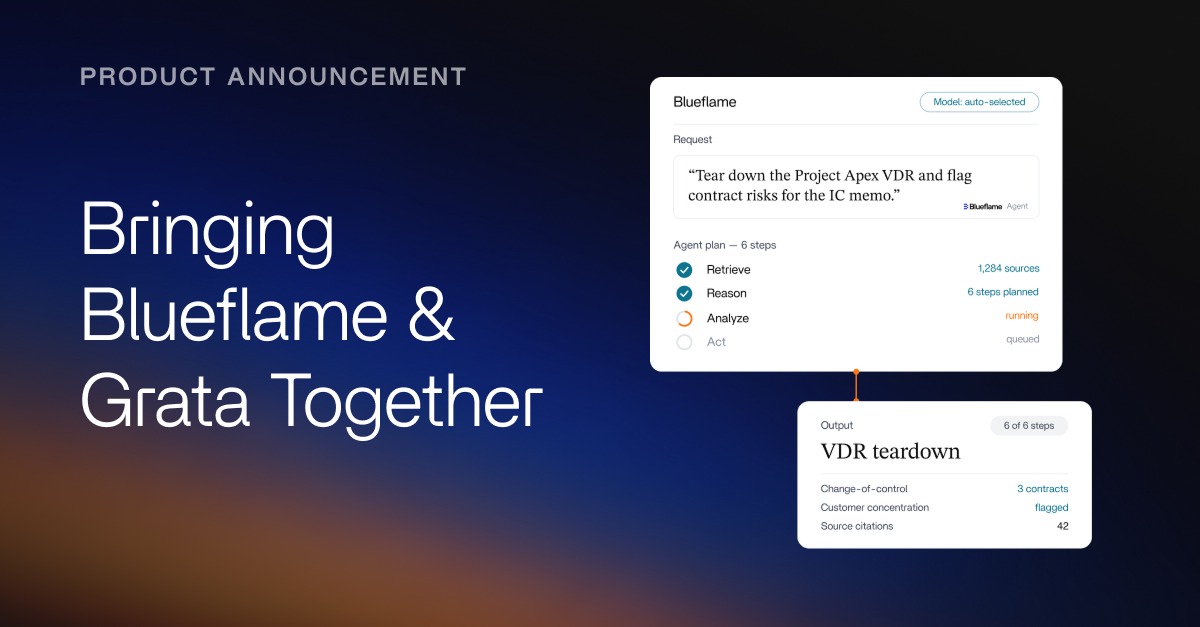

Ask an AI model to answer a question, and it will.
However, ask it to run a workflow across your data, systems, permissions, and it stops — why?
It’s not because it isn’t smart enough, but because intelligence alone isn’t infrastructure.
Infrastructure is what makes intelligence operational: the connective layer across data, tools, and permissions that determine whether a model can move from producing outputs to acting inside real systems.
That's why your LLM can answer questions but can't run your workflow. The model isn't the problem; what's missing is the orchestration layer around it.
What is an AI harness?
An AI harness is the orchestration layer that empowers the AI agent to plan, act, and recover across long-running tasks.
Consider the harness as the bridge between AI models and investment workflows — the AI model provides intelligence; the AI harness makes that intelligence operable.
AI Agent = AI Model + AI Harness
The harness encompasses all the systems surrounding the model:
- Workflow orchestration and routing logic
- Tools, APIs, and Model Context Protocol (MCP) integrations
- Retrieval and memory systems
- Feedback loops and validation checks
- Permissions and governance controls
- Context management across tasks
What is the difference between an AI model, an AI agent, and an AI harness?
An AI model is the core intelligence that generates outputs — text, predictions, or classifications — based on patterns learned from data. It does not inherently know the user’s workflow, tools, or objectives beyond a single prompt.
On the other hand, an AI agent builds onto a model by giving it autonomy: it can plan, take actions, and iterate toward a goal with limited supervision. However, agents can be inconsistent without structure, context, or governance.
An AI harness is the orchestration layer that sits above models and agents. It connects them to enterprise systems, data, permissions, workflows, and controls, ensuring outputs are reliable, auditable, and aligned with real operational processes.
How does an AI harness enhance AI agent performance?
AI agents become significantly more effective when paired with a harness layer.
Without one, agents tend to hallucinate when lacking grounded context, lose track of where they are in multi-step workflows, act inconsistently across similar tasks, and produce outputs with no audit trail.
The harness solves each of these failure modes directly — providing structured context, tool access, retrieval systems, memory, governance, and workflow logic.
How does an AI harness work in a real investment workflow?
Here’s what happens when a private equity associate is tasked with drafting an investment committee (IC) memo for a new target company, with and without an AI harness.
What are the signs that AI workflows are breaking in production?
In practice, the difference between “AI that works in demos” and “AI that works in investment workflows” shows up in a few predictable failure patterns.
If three or more of the below sound familiar, the issue is often the missing AI harness layer:
✔️ Your AI pilots demo well but never reach production. The AI model performs well in a controlled prompt but breaks when it retrieves data from another system.
✔️ Compliance won't sign off because there's no audit trail. Outputs can't be traced back to source documents, model versions, or decision logic. When a partner asks, "Where did this number come from?", no one can answer.
✔️ Different teams are building parallel AI tools that don't share context. Deal teams, investor relations, and operations each have their own workflow. None shares retrieval, memory, or governance.
✔️ Your data room and CRM permissions don't carry into AI workflows. Permission boundaries stop at the model's edge, so AI sees deals it shouldn't, or misses deals it should.
✔️ Outputs are inconsistent across similar tasks. The same prompt produces a different IC memo structure on Tuesday than it did on Monday.
✔️ Your agents hallucinate when the stakes are highest. Without grounded retrieval and validation, AI agents invent comps, fabricate quotes, or miscalculate multiples when accuracy matters most.
Frequently asked questions
What is an AI harness?
An AI harness is the orchestration layer that connects an AI agent to workflows, tools, data, memory, and governance controls, enabling the agent to complete real tasks inside an organization. Without a harness, an AI agent can generate responses but cannot act on a task.
Why do AI agents need a harness to work in financial services?
Financial services workflows demand auditability, permissions, and grounded context, none of which agents have on their own. A harness provides the retrieval, memory, governance, and workflow logic that allow AI agents to operate reliably inside compliance-sensitive environments such as the investment lifecycle.
The layer that connects AI to deal sourcing, screening, and due diligence
What separates the firms getting real value from AI from the ones still running pilots is the AI infrastructure around the model — the systems that connect it to workflows, enforce governance, retrieve the right context, and keep every action auditable.
Request a demo to see how Blueflame AI’s purpose-built platform turns fragmented AI into connected workflows.