
Behind every live M&A transaction is an analyst or associate updating pitch books, building comp tables, responding to comments, managing diligence requests, and ensuring every number ties before materials move up the chain.
Every deliverable depends on information scattered across the bank's tech stack, making retrieval and context-switching a significant part of the job.
Amp, Blueflame AI’s agent for dealmakers, eliminates that friction.
Securely connected to your bank's CRM, Microsoft 365, Datasite virtual data rooms (VDRs), internal documents, market data, and proprietary research, Amp retrieves and synthesizes trusted information so junior bankers spend less time searching and more time executing deals.
The foundation for this workflow is within Blueflame Spaces.
Each transaction can have a dedicated Space that brings together the emails, documents, CRM records, financial models, diligence materials, research, and Datasite VDR content that power the deal, creating a single source of truth from kickoff through closing. Working across everything in that Space, Amp provides contextual answers, drafts deliverables, and helps teams move seamlessly through every stage of the M&A lifecycle.
The use cases below follow that journey, showing how junior investment banking use Blueflame AI Spaces and Amp from initial client coverage and pitch preparation through diligence, negotiation, and closing.
1. Coverage and relationship management
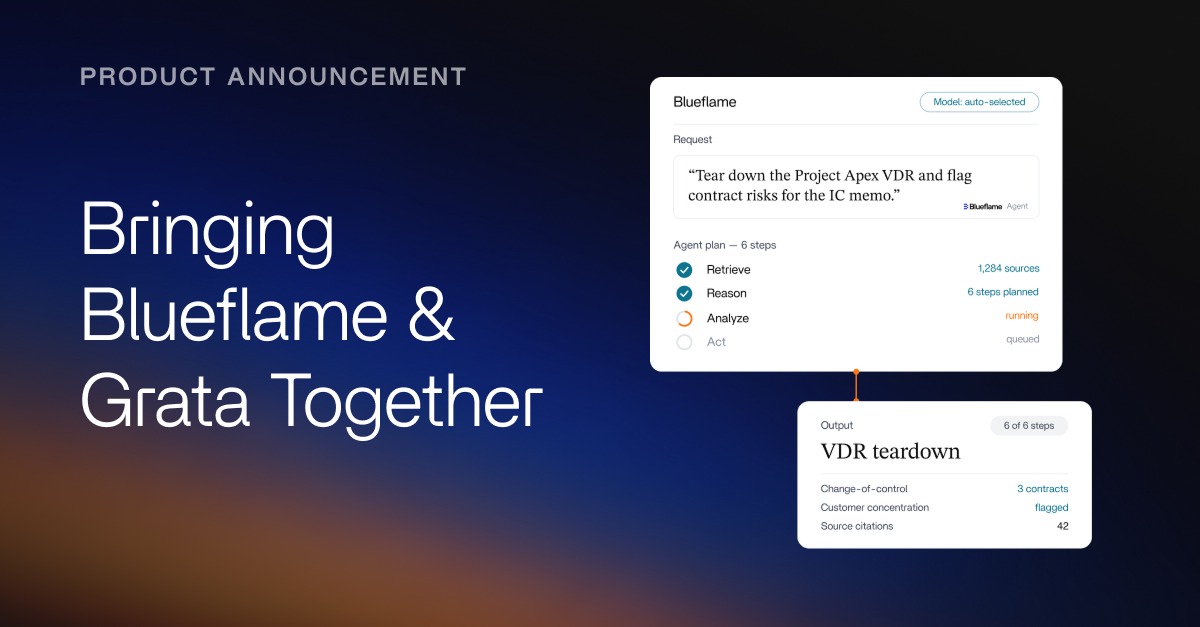
Every client interaction starts with preparation. Before a coverage meeting, junior bankers often spend hours reviewing earnings transcripts, SEC filings, CRM notes, research, and recent news just to get up to speed.
Blueflame Spaces can bring those sources together, while Amp can retrieve and synthesize data into a single briefing, so deal teams spend less time gathering information and more time preparing for the discussion.
How junior bankers use Blueflame for coverage and relationship management:
- Generate pre-meeting briefings using CRM records, earnings transcripts, filings, news, and internal research
- Surface prior client interactions and relationship history from CRM records
- Build executive, board, and advisor profiles before meetings
- Keep trading comps and precedent transactions refreshed with the latest market activity
2. Pitch book development
No one wants to rebuild the same pitch deck for the fifth time.
With previous pitch books, credentials, research, and market data already stored in the Space, Blueflame builds on your firm's institutional knowledge — so associates can spend less time starting from scratch and more time refining the story.
How junior bankers use Blueflame to build pitch books:
- Draft company overviews and business descriptions
- Retrieve relevant credentials and tombstones from prior transactions
- Build trading comps and precedent transaction analyses
- Generate first-pass valuation summaries and football fields
- Perform quality-control checks for broken references, inconsistent numbers, outdated logos, and formatting issues
3. Deal kick-off and workspace setup
Kick-offs are notoriously informal, with inconsistent folders, ad hoc naming conventions, and a scramble to orient new team members. Blueflame Spaces brings structure to the process from day one by creating a dedicated workspace for every transaction.
As the deal kicks off, junior bankers can connect CRM records, Outlook conversations, the Datasite VDR, financial models, and supporting documents into a single Space.
Standardized folder structures, templates, and permissions give every team member a consistent starting point, while Amp works across the complete deal context as it evolves.
How junior bankers use Blueflame to streamline deal kick-offs:
- Set up dedicated Spaces for each deal with standardized folder architecture
- Connect CRM records, Outlook emails, and Datasite VDRs to the deal Space
- Populate IRL, model, CIM, and buyer-list templates at launch
- Generate onboarding briefs for new deal team members
- Invite deal team members with appropriate permissions and access
4. Financial modeling
Bankers often spend more time cleaning historical financials than analyzing them. Amp accelerates the early stages of modeling by extracting financial data, identifying normalization adjustments, and helping build a structured foundation for forecasting work.
How junior bankers use Blueflame for financial modeling:
- Normalize historical financial statements
- Identify non-recurring EBITDA adjustments
- Build an initial three-statement model in Excel
- Benchmark assumptions against peers and historical performance
- Generate DCFs, trading comps, precedent transactions, and sensitivity analyses
5. Equity story and CIM development
Creating a compelling equity story and drafting the CIM is one of the most time-intensive parts of a sell-side process.
Rather than beginning with a blank document, Amp drafts the CIM using the source materials already collected in the deal Space, ensuring every section stays grounded in the latest information.
How junior bankers use Blueflame to draft CIMs:
- Draft executive summaries and investment highlights
- Generate business overview, customer, market, and competitive analysis
- Create management biographies
- Populate financial exhibits directly from the financial model
- Produce teaser documents alongside the CIM
6. Buyer identification and process preparation
Finding the right buyers isn't just about industry keywords.
Blueflame can combine trusted market intelligence from its integration with Grata and other providers with CRMs like DealCloud, Affinity, and Salesforce, plus your firm’s historical mandates, sponsor activity, and relationship network to generate a prioritized buyer universe with supporting rationale for every recommendation.
How junior bankers use Blueflame for buyer identification:
- Identify strategic buyers and financial sponsors
- Analyze portfolio company overlap and acquisition history
- Surface dry powder, investment focus, and recent transaction activity
- Score buyer fit based on industry, geography, and transaction history
- Map warm introductions using CRM relationships and prior firm engagements
7. Buyer outreach and process management
Managing a competitive process means coordinating dozens, or sometimes hundreds, of buyer interactions at once. Blueflame helps associates keep every moving piece organized by connecting email, CRM records, NDA workflows, and live Datasite data room activity into a single view.
How junior bankers use Blueflame for buyer outreach:
- Draft personalized buyer outreach emails
- Track teaser, CIM, and NDA status across the buyer list
- Generate buyer-specific briefing notes before management presentations
- Summarize buyer feedback and identify emerging themes throughout the process
8. Due diligence and VDRs
Once diligence begins, junior bankers spend much of their time answering buyer questions, locating supporting documents, and ensuring every deliverable tells a consistent story.
Amp can search across the VDR, Microsoft Outlook, and supporting files all within a Space to draft responses grounded in source documents.
How junior bankers use Blueflame for due diligence:
- Draft responses to buyer diligence questions
- Locate supporting documentation across the VDR and internal files
- Cross-check CIM disclosures against diligence materials
- Identify missing, inconsistent, or outdated documentation
- Build customer concentration, working capital, and revenue analyses on demand
9. Bid evaluation and negotiation support
Every indication of interest (IOI) and letter of intent (LOI) arrives in a different format. Amp can extract key commercial terms from buyer submissions and organizes them into standardized comparison frameworks, helping deal teams evaluate offers and manage the negotiation more efficiently.
How junior bankers use Blueflame for bid evaluation and negotiation:
- Compare valuation ranges across bidders
- Extract letters of intent and sales and purchase agreements (SPA) into a single comparison framework
- Maintain the issues list, aggregating open negotiation points from counsel email threads
- Model purchase price adjustment mechanics, including working-capital targets and net-debt definitions
- Generate side-by-side comparison materials for internal decision-making
10. Quality control and document review
The final review before materials go out can take as long as creating them.
Amp can review financial models, presentations, CIMs, and supporting documents to identify inconsistencies before they reach clients or buyers.
How junior bankers use Blueflame for quality control and document review:
- Verify numbers across pitch books, CIMs, models, and presentations
- Detect inconsistencies between Excel and PowerPoint deliverables
- Flag broken references, outdated exhibits, and formatting issues
- Compare document versions to identify substantive changes
- Validate footnotes and supporting source materials
11. Legal and regulatory workstreams
The legal phase is document-heavy and detail-critical — exactly the kind of systematic cross-checking junior bankers dread doing by hand.
Working across the Space, Amp can scan contracts and disclosures against the underlying record to keep the legal workstream consistent with everything the deal team has already represented.
How junior bankers use Blueflame to streamline legal and regulatory work:
- Cross-check disclosure schedules against the VDR and CIM content for consistency
- Scan contracts to identify change-of-control and consent provisions
- Assemble data and narrative to support antitrust and regulatory filings
- Flag discrepancies between legal drafts and the diligence record
12. Closing and deal administration
As transactions approach signing and closing, administrative work accelerates and precision becomes everything; every line must tie back to a legal agreement.
The Space contains the complete history of the transaction — from the first pitch materials to executed agreements — making it easy to archive the deal, update credentials, and reuse institutional knowledge on future mandates.
How junior bankers use Blueflame for deal closing:
- Build and cross-check the funds flow against the SPA, credit agreement, and engagement letter
- Assemble closing binders from executed documents
- Update CRM and internal deal databases
- Archive final deal materials so the next pitch starts with a fresh credential
Frequently asked questions
What does an investment banking junior do across the deal lifecycle?
An IB associate or analyst turns analysis into buyer-facing materials and runs the deal process — building pitch books and CIMs, running valuation, coordinating vendor due diligence, managing buyer outreach and Q&A, maintaining the data room, and assembling closing documents as the funds flow — across all stages from coverage to close.
Can Blueflame AI write a CIM?
Yes, Blueflame AI can produce a structured first draft of a CIM — executive summary, business description, customer and competitive analysis, management bios, and integrated financial exhibits — from source materials.
What are Blueflame AI’s Spaces?
A Blueflame Space is a secure workspace that centralizes everything related to a deal. Each Space serves as a dedicated home for the files, notes, emails, CRM records, financial models, Datasite VDR content, and other work surrounding a transaction, allowing deal teams to collaborate across multiple sessions without losing context.
Which parts of the M&A deal process can AI actually help with?
Blueflame AI can help with over 50 junior-level tasks across all stages of the deal lifecycle — coverage, pitch prep, kick-off, deal prep, CIM, targeting, marketing, first round, management presentations, VDR and diligence, final bids, exclusivity, legal, regulatory, and closing.
Does AI replace investment banking juniors?
No. It removes repetitive construction and process-management work, so junior bankers can focus on judgment, client narrative, and deal instinct.
Discover purpose-built AI for investment banking
Every deal depends on getting the right information to the right people at the right time.
Blueflame Spaces provides a dedicated workspace where every document, conversation, financial model, and diligence artifact stays connected throughout the transaction. Working across that complete context, Amp helps deal teams retrieve trusted information, draft deliverables, and move work forward with greater speed and confidence.
With less time spent searching for information, rebuilding materials, and reconciling documents, deal teams can focus on the work that creates the most value: advising clients, driving transactions forward, and delivering better outcomes.
The result isn't fewer junior bankers; it's better-equipped ones. Together, Blueflame Spaces and Amp enable bankers to deliver higher-quality work with greater precision, consistency, and speed.
Request a demo to see how investment banks use Blueflame AI to accelerate sourcing, enhance relationship intelligence, and simplify execution across the entire deal lifecycle.