
An AI platform that can’t be governed, permissioned, and audited isn’t an accelerant — it’s a liability.
Investment firms and dealmakers are under pressure to move quickly on AI. However, our team has never believed speed should come at the expense of security.
Those principles have been built into the Blueflame AI platform from day one.
Our co-founders, Raj Bakhru and Henry Lindemann, built Blueflame AI with deep experience helping alternative investment firms manage cybersecurity and technology risk. As our platform has evolved, we've strengthened that foundation with a dedicated security, privacy, and governance function focused on continuously raising the bar.
That experience also gave us a clear understanding of why general partners, Chief Information Security Officers (CISOs), and compliance leaders hesitate before trusting AI with their most sensitive information.
We share those same concerns, and they've shaped every architectural decision we've made.
This article looks at how Blueflame AI approaches security, privacy, and governance, from platform architecture to the controls that protect financial data.
The Blueflame AI approach to security
Blueflame AI's architecture is designed around a simple principle: expose only the minimum amount of information required to complete a task.
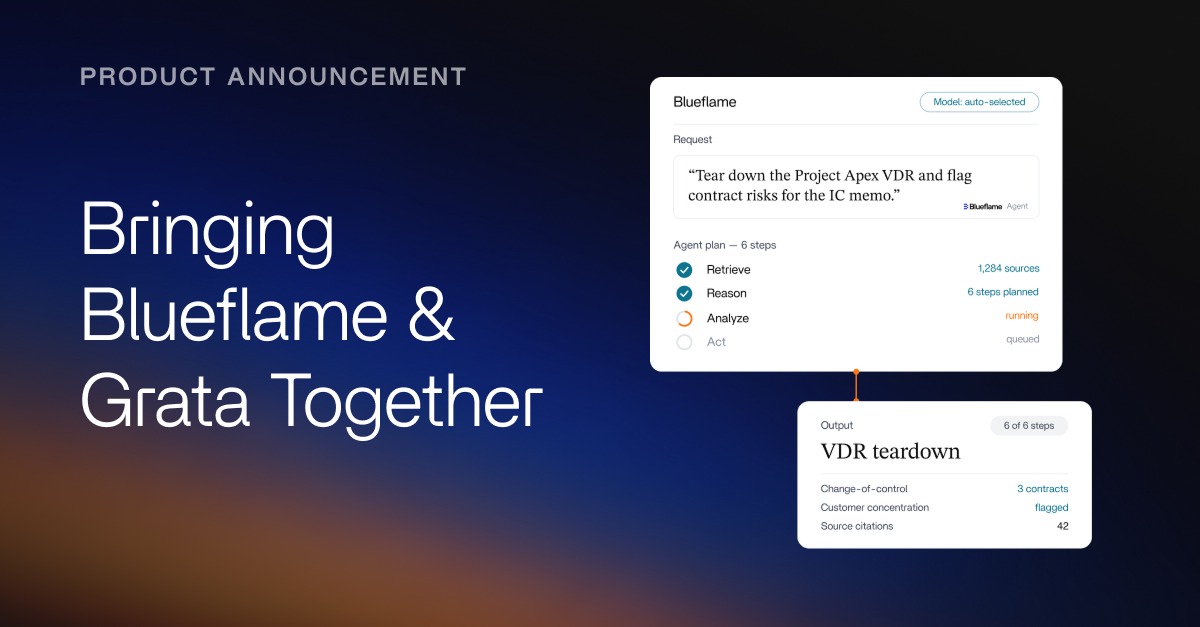
The orchestration layer that powers Blueflame AI's agent, Amp, determines what each request requires, retrieves only the relevant information, and routes each step to the AI model best suited for that task.
Rather than sending entire documents to a model provider, Blueflame AI limits the context shared with each model.
In practice, an AI model receives only the user's prompt, the specific document excerpts needed to answer the request, and the limited metadata required to process that interaction. Original documents remain within Blueflame AI's infrastructure — they are not stored or maintained by a model provider.
Blueflame's enterprise agreements with model providers also include zero-data-training and zero-data-retention commitments. Customer data is never used to train foundation models and is retained only for the time required to process each request.
This means that the intelligence users receive is grounded in their own data while minimizing unnecessary exposure throughout the process.
Strong architecture, however, is only one part of enterprise security.
Blueflame AI complements its platform design with independent security controls and operational governance, including:
- SOC 2 Type II attestation covering the Security, Availability, and Confidentiality Trust Services Criteria
- Continuous vulnerability scanning and risk-prioritized remediation
- Annual security policy reviews overseen by the company's Risk Committee
- Support for GDPR and CPRA compliance
- Regional deployments designed to support customer data residency and privacy requirements
How Blueflame AI protects financial data
Security isn’t a single feature — it’s a collection of architectural decisions and controls designed to reduce risk at every layer of the platform.
That means protecting data throughout its lifecycle: how it’s stored and processed, who can access it, what information AI models receive, and how activity is governed and audited.
Encryption and tenant isolation
Industry-standard encryption protects data both in transit and at rest, while strict tenant isolation ensures every customer's information remains logically separated from every other organization's data.
Permission-aware retrieval
Blueflame AI automatically respects permissions from SharePoint, Outlook, and other connected systems, ensuring users only receive information they're authorized to access.
Source-grounded responses
Responses include inline citations to source documents and show which AI model generated the answer. This makes it easier for users to review and verify the information before relying on it.
Regional data residency
Independent US and EU deployments keep storage, indexing, and inference within the customer's selected region to support regulatory and residency requirements.
Data lifecycle governance
Organizations can purge data on demand and rely on defined deletion timelines at contract termination to maintain control throughout the data lifecycle.
Comprehensive audit logging
Exportable audit logs capture prompts, retrieved context, and generated responses, with immutable archiving (retained for 7 years per SEC/SOX regulations) available to support compliance, investigations, and regulatory review.
Multi-model, model-agnostic orchestration
Blueflame AI's orchestration layer enables Blueflame’s agent to route each task to the best frontier model, allowing firms to benefit from new models as they emerge without becoming dependent on a single provider or renegotiating procurement every time the market evolves.
Enterprise-grade security, backed by Datasite
Blueflame AI's security program is further strengthened by Datasite's global organization.
Customers benefit from continuous application and cloud security testing, ongoing risk monitoring, and enterprise-grade security operations supported by leading tools for application security, cloud posture management, and threat detection.
Security isn't an annual compliance exercise. It's an ongoing engineering discipline that's embedded throughout how the platform is designed, tested, and operated.
Frequently asked questions
Does Blueflame AI use customer data to train AI models?
No, Blueflame AI does not use customer data to train foundation models. Our enterprise agreements with AI model providers include zero-data-training commitments, ensuring customer prompts and content are not used to improve or retrain third-party models. Customer data is processed only to fulfill the requested task and is handled in accordance with our security and privacy commitments.
Where is customer data stored in Blueflame AI?
Customer documents and source content remain within Blueflame AI's infrastructure. AI models receive only the information required to complete a specific task. They do not store or maintain customers' original documents. Blueflame AI also offers independent US and EU deployments to support customers' regional data residency and regulatory requirements.
How does Blueflame AI enforce document permissions?
Blueflame AI respects existing permissions from connected enterprise systems, including Microsoft 365, SharePoint, email, and collaboration platforms. Users can only retrieve or interact with content they are already authorized to access, helping organizations extend their existing security model into AI-powered workflows.
Does Blueflame AI support data residency requirements?
Yes, Blueflame AI offers independent regional deployments that allow customers to keep storage, indexing, and AI inference within their chosen geographic region. This architecture helps organizations meet regulatory obligations and internal policies related to data residency and privacy.
Is Blueflame AI SOC 2 Type II compliant?
Yes. Blueflame AI maintains a SOC 2 Type II attestation covering the Security, Availability, and Confidentiality Trust Services Criteria. The platform is also supported by continuous vulnerability scanning, formal security governance, and compliance with privacy regulations, including GDPR and the California Privacy Rights Act (CPRA).
Are firms locked into a specific AI model?
Blueflame AI uses a model-agnostic orchestration layer that enables organizations to leverage leading AI models as the market evolves. This approach reduces vendor lock-in and gives customers the flexibility to adopt new models without redesigning workflows or migrating their data.
What happens to customer data when a contract ends?
Blueflame AI provides defined data lifecycle and deletion processes. Upon contract termination, customer data is deleted in accordance with agreed contractual terms and established deletion timelines.
Secure AI without compromise
AI adoption shouldn’t require a choice between innovation and control.
For investment firms and dealmakers, the ability to move faster with AI depends on having the right foundation in place — one that protects sensitive data, preserves existing permissions, provides transparency, and gives firms control over how their information is used.
That’s the approach behind Blueflame AI.
Security, privacy, and governance aren’t features layered onto the platform; they’re built into how it handles data, connects to enterprise systems, and delivers AI-powered intelligence.