
Recently, we brought together a small group of Blueflame AI power users to explore where AI is delivering the most impact in investment management today, as well as to push the boundaries of what’s possible with AI in investment workflows.
The conversations highlighted both the pace of innovation and the gap between what AI can do and how it’s being used today.
AI is advancing faster than adoption
AI capabilities are accelerating at a remarkable pace, but adoption is still in its early stages. Across industries, usage remains limited not because the technology isn’t ready, but because many teams are still learning what’s possible.
At the same time, the underlying progress is clear:
- AI-assisted development is accelerating dramatically, with teams increasingly relying on AI to write, review, and improve code across many workflows
- New architecture and training approaches for LLMs, like diffusion models, are unlocking step-function improvements in performance and capabilities
- Open source and specialized models like Meta LLaMA, Mistral, DeepSeek, and others are rapidly closing the gap with foundation models, while reducing cost and latency
The gap between what AI can do and how it’s being used is still wide but closing quickly.
"[AI] technology is progressing quickly, and the capabilities of the technology are beyond where users work today. There's a huge adoption and training gap, but, increasingly, the only limit on adoption is creativity — knowing what's possible and knowing what you can do." — Henry Lindemann, Chief Growth Officer at Blueflame AI
The evolution from isolated prompts to integrated workflows
Another major theme was the shift from “prompt-first” usage of AI to integrated, system-level workflows.
Early AI adoption in investment management has largely been centered around one-off tasks: generating content, answering questions, or summarizing documents, but that’s starting to change.
The next phase of AI adoption is embedding AI across entire workflows—where context persists; collaboration is seamless, and outputs build on each other over time. Instead of isolated prompts, teams are moving toward purpose-built AI systems that support how they actually work.
In practice, this looks like deal-centric workspaces that organize sourcing, diligence, and portfolio work in one place; AI-drafted reports within deal workflows for review and iteration; and proactive intelligence feeds that surface relevant updates (from market data to internal activity) without requiring users to build everything themselves.
As the AI landscape continues to evolve rapidly, this shift toward workflow-level integration is becoming even more critical.
Where AI is delivering value in investment management today
Although AI adoption in investment management is still relatively nascent, many AI use cases for private equity and investment banking are already proving effective, including:
- Business development and outreach: Company research, target sourcing and screening via Grata, and bulk personalized outreach
- Deal marketing (investment banking): Comparable company analysis, teaser and marketing content creation, strategic and financial buyer lists, and CIM / pitchbook generation
- Investor relations: LP meeting preparation and briefings, DDQ response automation, LP quarterly letter drafting, and automated CRM data entry
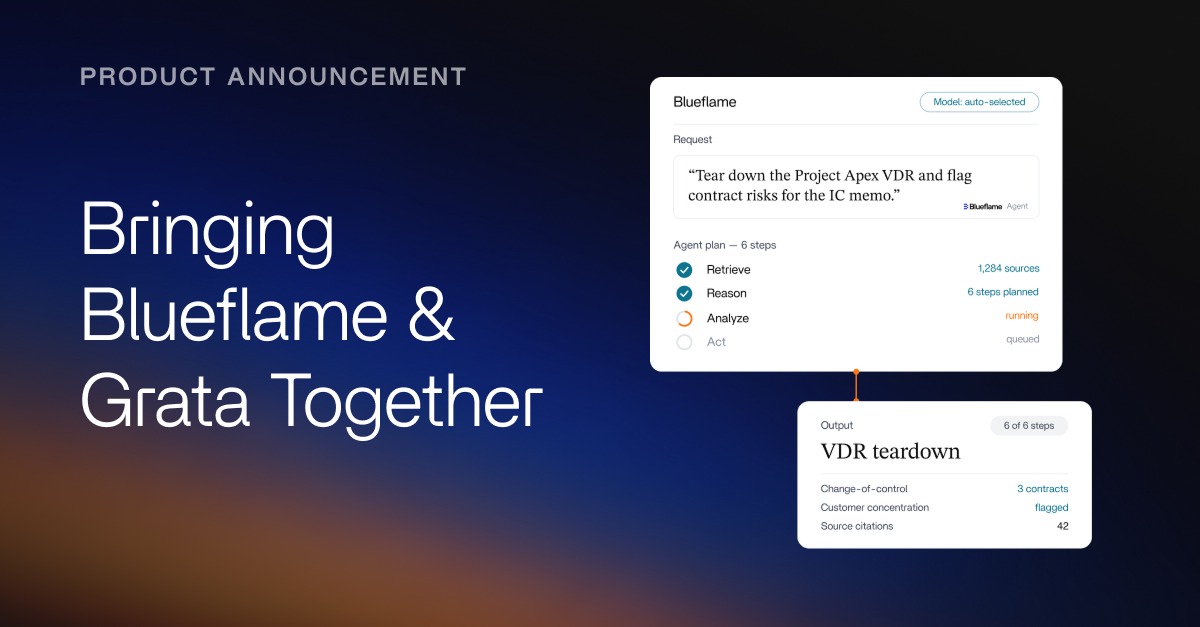
- Diligence: CIM data extraction and summarizations, expert network call transcript synthesis, contract and NDA term extraction, VDR teardown and issue extraction, LBO model builds, and others
- Portfolio monitoring: Industry and competitor news monitoring, portfolio KPI tracking and alerts, and others emerging

A people-first approach to AI
While the technology continues to evolve, one theme remained constant throughout every discussion: the importance of building with and for our users.
The most valuable insights came from real-world challenges:
- Where workflows break down
- Where outputs need to be more reliable
- Where collaboration and context are missing
These conversations shape how we prioritize what we build next.
Because AI isn’t just about capability, it’s about usability. And the teams that get the most out of it aren’t just adopting new tools; they’re rethinking how they work.
What Blueflame AI is building next
As AI capabilities continue to advance, we're evolving the platform in lockstep with a multi-model architecture to help clients drive deeper adoption across their workflows. That evolution is directly grounded in what we’re hearing from clients, which includes reducing fragmentation and making AI more usable in daily workflows to prioritizing use cases that drive AI ROI for our clients.
- Collaborative project workspaces (Spaces): Dedicated environments that enable teams to centralize data, chats, files, and notes with context that persists across the lifecycle of a deal or project.
- More flexible integrations via MCP: Expanding connectivity across internal systems and third-party sources via Model Context Protocol (MCP), making it easier to access and act on data using natural language.
- More relevant search results: Implementing Graph-based Retrieval-Augmented Generation (GraphRAG) to deliver sharper, more precise insights.
AI is quickly becoming foundational to how investment teams operate. But the real impact comes from connecting it to real workflows, real data, and real people.
That’s where we’re focused and what we’re continuing to build toward.