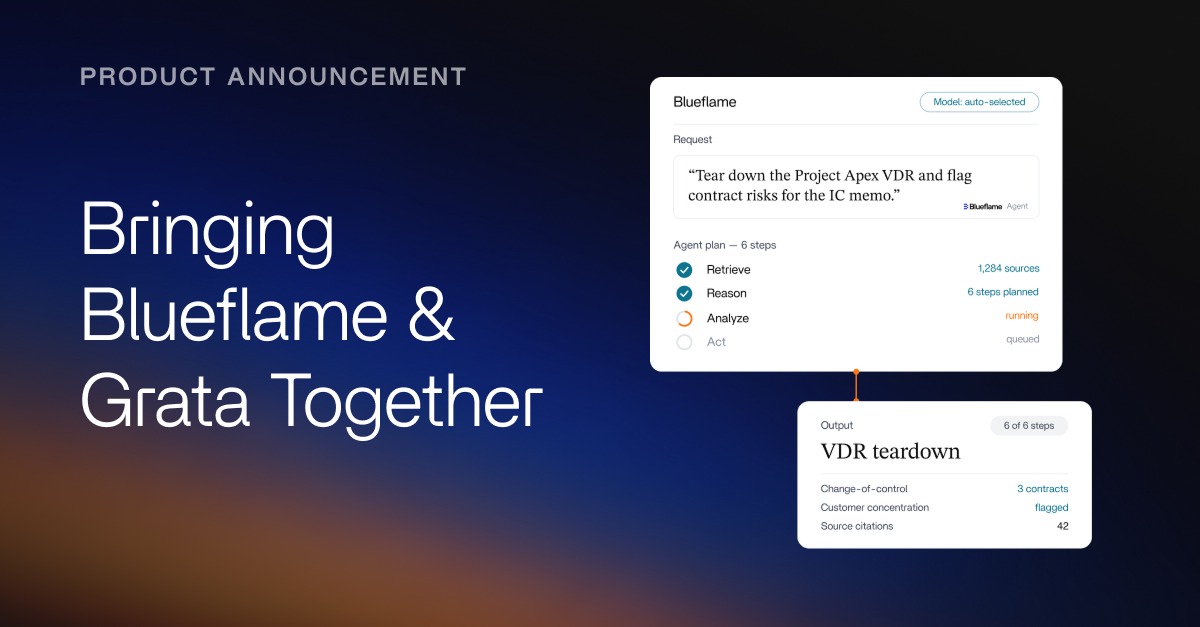

AI is already speeding up many M&A tasks. But speed is only the beginning of what agentic AI can bring to the industry.
The bigger shift is from helping dealmakers answer questions to taking on more complex workflows that move deals forward.
That means going beyond Q&A and responding to one-off requests. An AI agent can work toward a broader objective — gathering relevant context, reasoning across sources, using models and tools, and coordinating multiple steps along the way.
The result isn’t just faster work. By taking on more end-to-end workflows, agentic AI can expand a dealmaker’s capacity to focus on the right opportunities, and get more, better deals done.
What is the difference between agentic and generative AI?
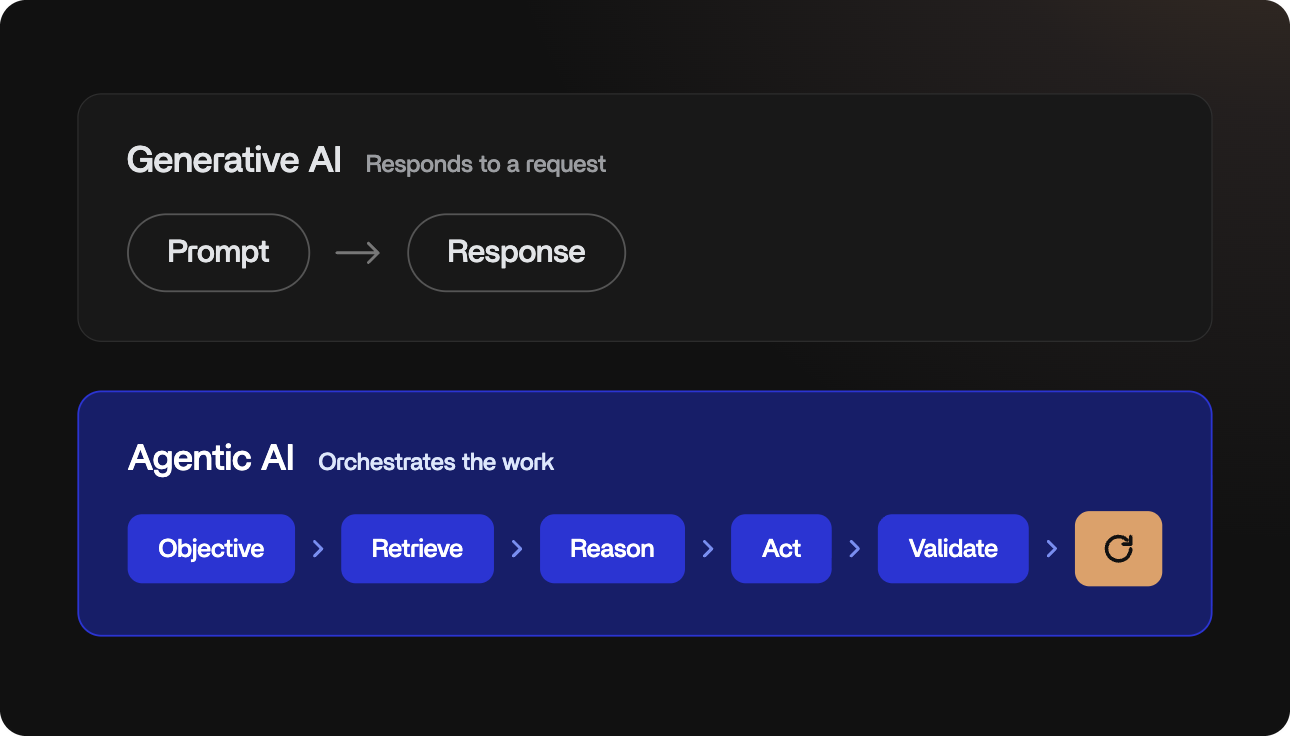
Generative AI is largely prompt-driven: you ask it to summarize a CIM, research a company, or draft an analysis, and it produces a response.
Agentic AI can take on a broader objective and work through the steps needed to accomplish it.
For example, instead of only summarizing a CIM, an agent can analyze the company, pull relevant market data, compare it with peers, flag areas for further diligence, and use those findings to inform the next step.
The difference looks something like this:
That doesn’t mean the AI agent works independently at every step.
A dealmaker should still review an analysis, approve an action, provide direction, or make the judgment calls that require their expertise.
The key difference is that the dealmaker doesn’t have to prompt and manage every individual AI task. The agent can help carry the work from one step to the next.
What does agentic AI look like in an investment workflow?
The difference between agentic and generative AI becomes clearer when you look at how the work unfolds across the lifecycle of an actual deal.
Consider the evaluation of a new investment opportunity.
A dealmaker could ask an AI model to summarize the CIM. An agent could use that CIM as one input into a broader workflow, bringing in other relevant data and context and carrying the work forward as the opportunity progresses.
For example, it could:
- Research and screen the opportunity: Pull relevant company and market data, assess the business against the firm’s investment criteria, and surface previous research or interactions.
- Build the analysis: Compare the company with relevant peers and transactions, reason across multiple sources, and identify areas that warrant further investigation.
- Support due diligence: Review new documents, extract key information, identify inconsistencies or potential risks, and keep track of open questions.
- Update the work as the deal evolves: Incorporate new findings into analyses and investment materials rather than starting from scratch each time new information arrives.
- Carry context forward: Retain relevant findings, decisions, interactions, and open questions so later work can build on what the team has already learned rather than reconstructing that context each time.
- Monitor what changes: Track relevant developments and evaluate new information in the context of the opportunity and the firm’s existing knowledge.
The value of connecting that work goes beyond efficiency.
An agent can carry research, analysis, and context from one step to the next, reducing the need for dealmakers to orchestrate each task. That creates more capacity to evaluate where to focus, apply judgment, and act.
Why firm knowledge and deal context are critical to agentic AI
The quality of the work an AI agent can execute depends in large part on the context it has to work with. And in M&A, that context rarely lives in one place.
A firm may have evaluated the company before; a senior dealmaker may know its founder; the team may have researched the market for another opportunity; or new diligence may change what the team believed two weeks earlier.
For an AI agent to work effectively, it needs to bring together the relevant pieces of that picture: market and company data, transaction information, firm knowledge and relationships, VDR content, deal documents, previous analysis, and what the team learns as the opportunity progresses.
Together, that information becomes the context the agent works from. But more information isn’t necessarily better. The agent needs to retrieve what matters for the task and carry forward what it learns, so each step builds an evolving understanding of the opportunity rather than starting from scratch.
That becomes even more important as AI moves from answering individual questions to executing work across multiple steps.
Frequently asked questions
What is an AI agent in M&A?
An AI agent is a system that can work toward an objective rather than simply respond to an individual prompt. It can retrieve information, reason across sources, use tools, and carry out multiple steps as part of a workflow. In M&A, that could include work across sourcing, screening, research, diligence, analysis, and monitoring.
What is an agentic workflow?
An agentic workflow is a multi-step process in which an AI agent works toward an objective by determining what needs to be done and coordinating the data, context, models, and tools needed to do it. In M&A, that could mean researching a company, analyzing comparable businesses, reviewing deal documents, and using those findings to inform the work that follows.
Are AI agents fully autonomous?
Not necessarily. AI agents can operate with different levels of autonomy depending on the workflow. They may complete some steps independently while pausing for human input, review, or approval when judgment is needed.
Why does context matter for AI agents in M&A?
Context gives an AI agent the information it needs to understand an opportunity the way the firm does. That can include market and company data, transaction information, firm research, relationships, prior interactions, deal documents, and new findings as the deal progresses.
Where can AI agents be used in the M&A lifecycle?
AI agents such as Blueflame’s dealmaking agent, Amp, can support work across the M&A lifecycle, from sourcing and research through diligence, analysis, execution, and monitoring. They can take on multi-step workflows within each stage and carry relevant information and context forward as the opportunity or deal progresses.
Agentic AI moves deal work forward
Agentic AI goes beyond making individual tasks faster by taking on more of the connected work required to move a deal forward.
As AI executes more of that work, it expands dealmakers’ capacity to evaluate opportunities, focus on where they have conviction, apply their judgment, build relationships, and act on the opportunities that matter.
Ready to move from AI that assists to AI that gets the work done? Request a demo of Blueflame’s dealmaking agent, Amp, today.