Even the best chess player in the world would struggle to win a game blindfolded. No matter how skilled or strategic they are, they can't make their best moves if they can't see the board. The same principle applies to AI in M&A.
AI can take hours out of sourcing, diligence, and analysis, but without visibility into the full market and deal context, all that speed can end up taking teams in the wrong direction.
That's the visibility problem Grata Intelligence was built to solve.
By bringing together proprietary market data, firm knowledge, transaction history, and evolving deal context, Grata Intelligence gives dealmakers a more complete picture to work from.
And with Blueflame, Datasite's M&A agent, that connected intelligence goes beyond insights to help execute the workflows that move deals forward.
So, what does better AI visibility look like in M&A?
Here are four ways Grata Intelligence helps teams know more, do more, and win more.
1. Surfacing the targets others miss
Most frontier AI models rely on publicly available information, and in private markets, that’s where the biggest blind spots tend to be — whether it’s a founder-owned business that rarely makes the news or a company that has started quietly preparing for a sale.
Grata Intelligence combines proprietary company data with seller intent signals so that teams can spot these opportunities earlier and decide which ones deserve attention while there’s still time to get ahead of a formal process.
For a private equity firm looking for targets in a niche sector, Grata Intelligence can uncover privately held companies that might otherwise fly under the radar and use seller intent signals to prioritize outreach.
2. Bringing your firm’s own knowledge into view
Somewhere in your firm’s files is a pass memo on a company that looked too small three years ago but might be exactly the right size today. There may also be call notes from a partner who already knows the founder, or a model someone built on the closest comparable company.
The trouble is that this kind of knowledge usually sits in CRMs, shared drives, and old email threads, and it tends to surface only if the right person happens to remember it.
Grata Intelligence connects that internal history with external market data, so both the deal team and Blueflame can pick up where the firm left off.
When that company comes back across the team's desk, Blueflame can draw on prior investment memos, internal research, and current market intelligence to help screen the opportunity against the firm's investment criteria — without starting the analysis from scratch.
3. Keeping the full deal picture current from first look to close
A deal rarely looks the same at the end as it did at the start. Diligence findings can shift the investment thesis; new bidders can enter the picture, and timelines can change.
When those updates live in different systems, or in team members’ heads, important details can get lost as the deal moves from one stage to the next.
Grata Intelligence keeps live deal context connected to market data, transaction data, and firm knowledge, so everyone working on the deal, including Blueflame, is operating from the same up-to-date picture from first look through closing.
During a live deal, new financials may surface in the virtual data room (VDR), while expert calls uncover new market risks or considerations.
With that information connected to Grata Intelligence, Blueflame can build on the latest findings rather than relying on an outdated view of the opportunity.
4. Giving Blueflame the intelligence to execute complex M&A work
Having the full picture is only useful if a team can act on it. That’s where Blueflame comes in.
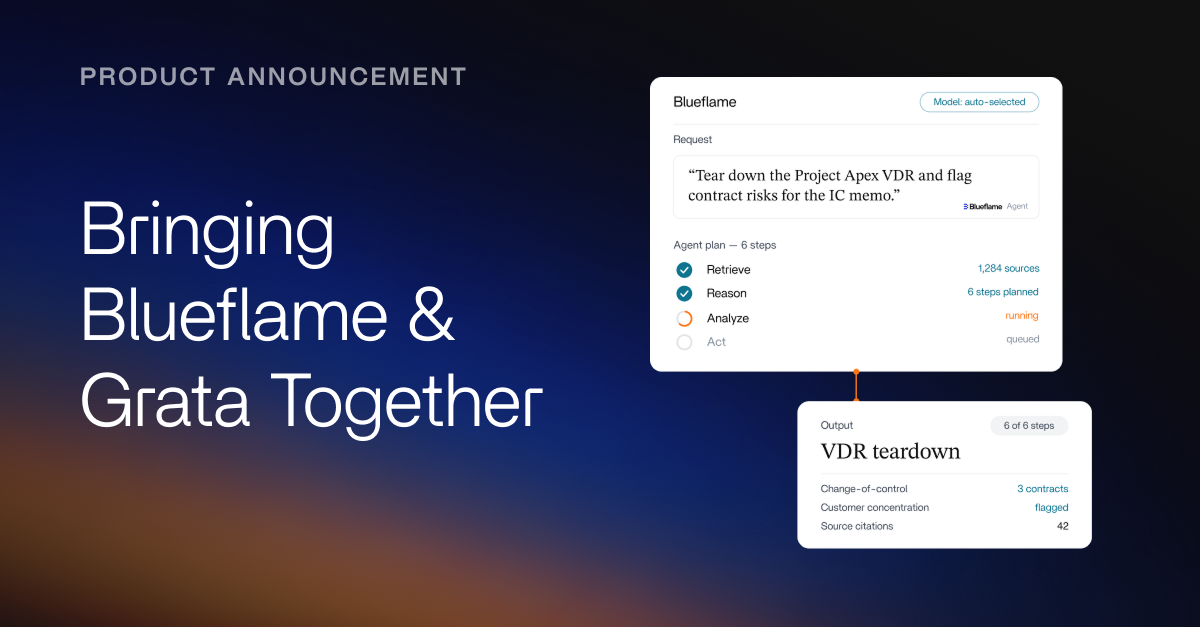
Working with the data in Grata Intelligence, the agent can retrieve information, reason through it, and carry out multi-step workflows spanning the entire deal lifecycle.
For a senior investment banker preparing a sell-side process, Blueflame can work across proprietary company intelligence, transaction history, and firm relationships to help build and validate a buyer list.
Instead of piecing together information from multiple sources, the banker has a more informed starting point for identifying strategic and financial buyers.
That’s the broader advantage of Grata Intelligence: giving dealmakers faster access to the information they need and the ability to act on it, so they can get more, better deals done.
The smartest moves in M&A start with better intelligence
In chess, the winning move isn't always the most obvious one.
Sometimes it's the opportunity several moves ahead that everyone else has overlooked, and recognizing it requires a clear view of how all the pieces fit together.
That's the edge Grata Intelligence brings to AI in M&A.
By giving Blueflame access to connected market intelligence, firm knowledge, and evolving deal context, Grata Intelligence helps dealmakers look beyond the obvious, prioritize the right opportunities, and turn insights into action.
Request a demo to discover what's possible with Grata Intelligence.