
For much of the AI industry, progress has meant more: bigger models, larger context windows, and the ability to process more tokens at once.
But more can come at a cost.
Every interaction with an AI model consumes tokens, and the cost can increase with the amount of information being processed, the model being used, and the complexity of the work.
For an individual prompt, that may seem relatively insignificant. However, across an investment firm, the economics can look very different.
As AI moves beyond simple queries and into complex, multi-step workflows, a single task can involve multiple model calls — each processing its own context and generating its own output.
Scale that across the firm and thousands of tasks, and inefficient token usage can become a significant expense.
For investment firms and dealmakers, the goal shouldn’t be to minimize token usage at the expense of the work. It’s to use AI resources deliberately: applying the right level of model capability and the right amount of deal context to produce high-quality results efficiently and expand how much meaningful work teams can accomplish.
What is AI token efficiency?
Tokens are the units AI models use to process inputs and generate outputs. The more information a model has to process, the more tokens it typically consumes.
However, token efficiency isn’t about using as few tokens as possible.
For example, a shorter AI prompt isn’t efficient if it leaves out critical information and produces a worse result, just as a cheaper AI model isn’t efficient if the work must be redone.
Optimizing your token usage means leveraging a platform that matches the right model and the right amount of context to the task, so AI can deliver strong results without unnecessary processing or cost.
How data quality affects AI token usage
Token efficiency starts long before deal information reaches a model.
When a firm’s data is duplicated, inconsistently structured, or scattered across systems, the model has to spend more of its context making sense of the inputs before it can get to the actual work.
The same is true when important context is missing and has to be reconstructed with each request.
A stronger data foundation removes some of that burden. By integrating, normalizing, and preparing trusted information upstream, the model can work from cleaner inputs and use its capacity for analysis, comparison, reasoning, and action instead.
For investment firms, that foundation should include more than external financial and market data.
For example, Grata can supply valuable company and market intelligence. However, when that intelligence — and the firm’s own research, interactions, relationships, and deal history — is captured and structured within the firm’s data layer, AI models don’t need to repeatedly retrieve and process the same underlying information every time they perform a task.
Instead, it can retrieve the specific intelligence the workflow requires. That means less raw information entering the model context window; fewer tokens spent reconstructing what the firm already knows, and potentially less reliance on repeated calls to external data sources.
Over time, the firm effectively builds its own reusable intelligence layer: one that becomes richer with every deal while making each subsequent AI workflow more efficient.
Bringing those sources together means AI can start with a better understanding of both the market and what the firm already knows, without having to process or reconstruct that history from scratch each time.
How AI systems improve token efficiency
Token efficiency isn’t achieved by simply cutting the amount of information an AI model processes. It comes from making smarter decisions about both the model doing the work and the information it receives.
For investment banking, private equity, and private credit firms, those decisions shouldn’t require teams to think about tokens, choose models, or determine how much context to provide.
They can happen behind the scenes, with an AI platform routing deal work to the appropriate models and retrieving the context each task requires.
In this case, two capabilities are particularly important: AI model routing and relevant-context retrieval.
Match the model to the task with AI model routing
AI model routing dynamically directs a task to the model best suited to complete it based on factors such as complexity, capability, speed, and cost.
This routing can happen within the AI harness: the orchestration layer that empowers the AI agent to plan, act, and recover across long-running tasks.
As a workflow progresses, the harness can determine which model is appropriate for each step rather than sending every task to the same model.
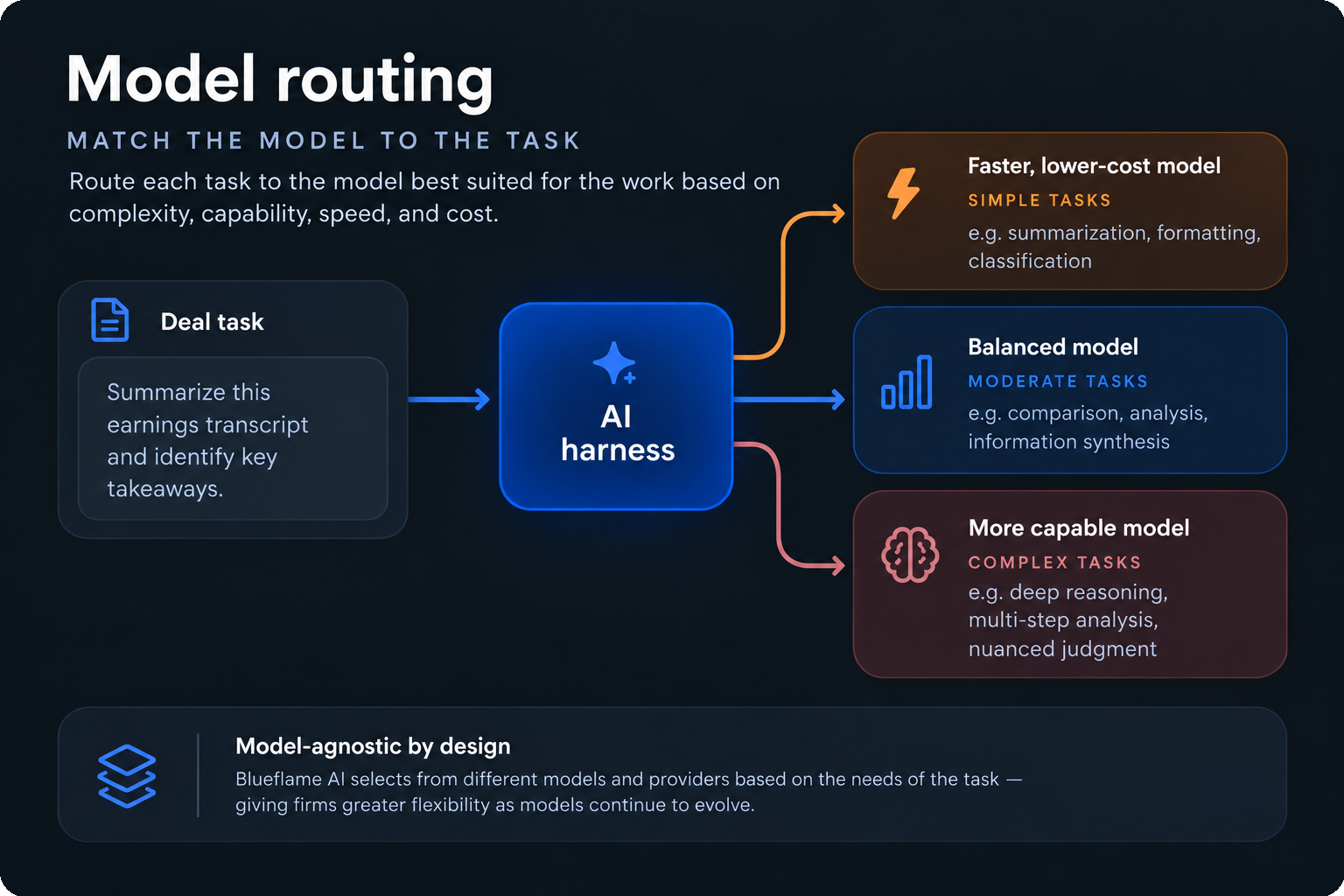
Rather than relying on the same model for every request, an AI platform can use faster, more economical models for simpler tasks while reserving more advanced models for work that requires deeper analysis or reasoning.
That’s also why Blueflame AI takes a model-agnostic approach. Blueflame selects from different models based on the given task, giving firms greater flexibility as models continue to evolve.
However, the point isn’t to avoid powerful models. It’s to use them when their added capabilities justify the additional time and cost.
That becomes even more important in multi-step financial workflows, where small inefficiencies can compound across dozens of model calls.
In an agentic workflow, the harness can make those routing decisions step by step, helping optimize the balance of speed, performance, and cost across the workflow.
Surface the right context with relevant-context retrieval
One of the most direct ways to reduce token usage is to limit how much unnecessary information a model has to process.
Rather than loading everything a firm knows into the context window, AI can retrieve only the information relevant to the task at hand.
A deal team may have evaluated a company before, spoken with its management team, researched its market, or worked on similar opportunities. That institutional knowledge can change how a new opportunity is understood, but it may be spread across years of documents, interactions, systems, and deal work.
Sending all of that information to the model every time would consume tokens without necessarily improving the result.
That’s where relevant-context retrieval identifies the information needed for the task before it reaches the model.
Advanced forms of this technology, such as graph-based retrieval-augmented generation or GraphRAG, can go further by using relationships between companies, people, deals, interactions, and other information to surface the institutional knowledge most relevant to the work.
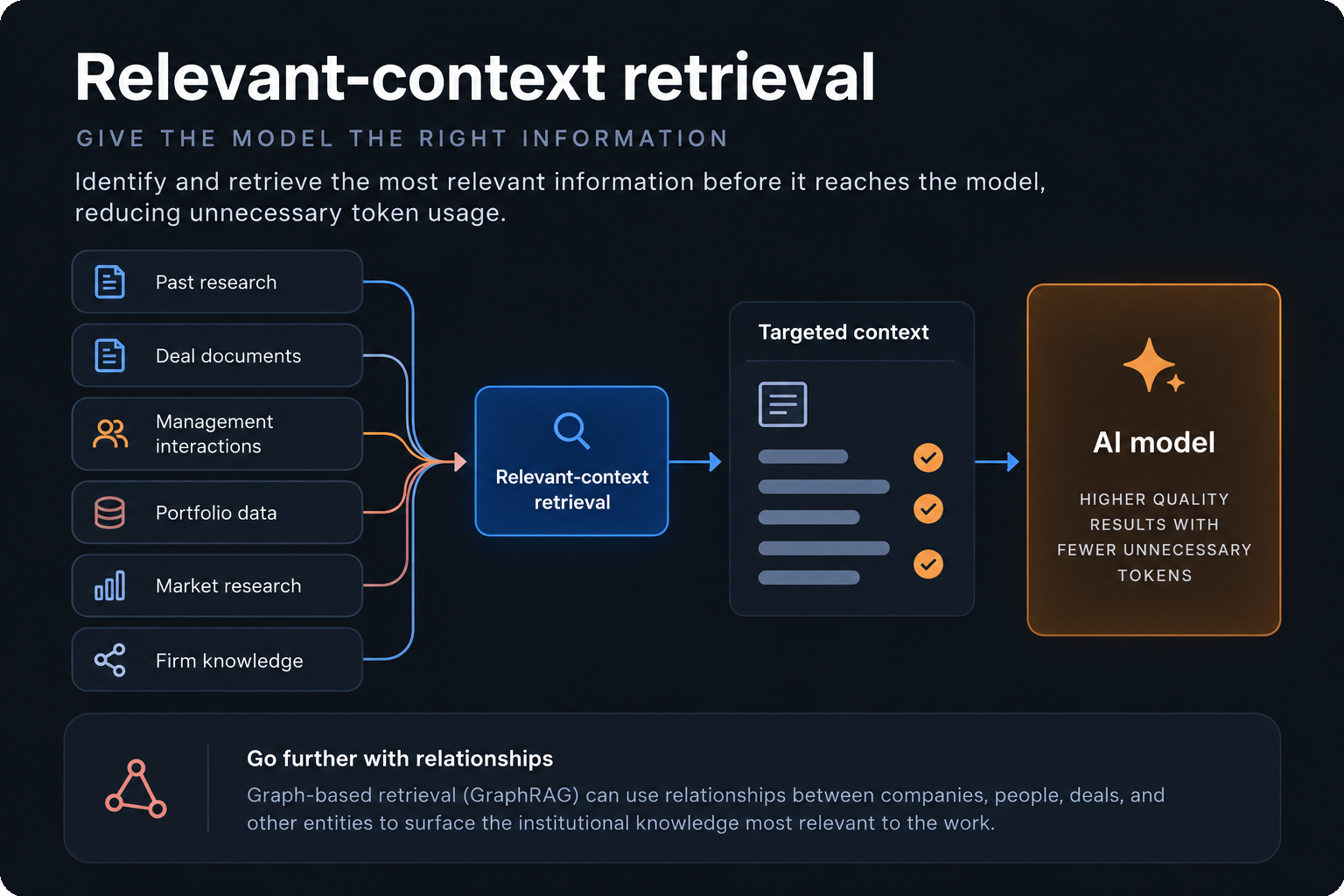
The model can then work from a smaller, more targeted set of context rather than reprocessing everything the firm knows. That reduces unnecessary token consumption while still giving the model the information it needs to do the work well.
Why token efficiency matters as AI takes on more deal work
The economics of AI change as AI takes on more work.
An agentic workflow isn't one action. It's a chain involving multiple steps: retrieve information, analyze data, reason across sources, generate outputs, validate the work, and decide what comes next.
Each of those steps may require its own model calls, token consumption, and context.
As a result, what looks like a single task to a dealmaker can involve significantly more processing behind the scenes. Inefficiencies that seem minor in one interaction can quickly compound across a workflow and across hundreds or thousands of tasks.
That’s where model routing, relevant-context retrieval, and data quality become increasingly important. Each step can use the level of model capability it requires, draw on the information relevant to the work, and start from data and institutional knowledge that are prepared for use.
As AI takes on more deal work, the important question becomes less about the cost of an individual token and more about the cost of completing the task.
Frequently asked questions
What are AI tokens?
AI tokens are the units models use to process and generate information. The more information a model takes in and produces, the more tokens it typically uses.
Do more tokens make AI more accurate?
Not necessarily. More tokens can provide useful context, but additional information doesn’t automatically improve the result. Performance also depends on the relevance and quality of the context, the model being used, and the complexity of the task.
Why does token efficiency matter for agentic AI?
Agentic workflows involve multiple steps, each of which can consume tokens. As those workflows scale across a firm, small inefficiencies can compound quickly, making token efficiency critical to controlling costs.
How token efficiency helps firms get more from AI
Firms face a constant capacity challenge: there are more opportunities to evaluate, more information to understand, and more valuable work to do than there is time to do it.
That’s why saving AI tokens isn’t the end goal; expanding what teams can accomplish is.
A more efficient AI architecture can apply resources where they create the most value, using the appropriate models, surfacing relevant context, and working from trusted data to support complex work across the deal lifecycle.
And that opportunity grows as AI gets closer to the intelligence that drives financial decisions: differentiated data, firm knowledge, and the evolving context surrounding each opportunity.
At Blueflame AI, we see the convergence of intelligence and execution as an important part of what comes next: AI that helps deal teams focus on what matters and expands their capacity to act.
As AI takes on more of the work behind dealmaking, efficiency will be measured not by how much AI can consume, but by how effectively it can turn intelligence into action.