
Imagine asking AI, "Which portfolio companies are exposed to a supplier involved in a pending acquisition?"
The answer isn't found in a single diligence report or financial model. It requires connecting information across data rooms, ownership structures, contracts, management teams, and third-party research.
The ability to answer questions like this is what separates AI that simply retrieves documents from AI that truly understands how information is connected.
One of the most important search and retrieval approaches making that possible is GraphRAG. It may sound technical, but the idea is surprisingly intuitive — and understanding it can help you evaluate whether an AI platform is built for complex, high-stakes investment workflows.
Let's break it down.
Defining GraphRAG
GraphRAG (graph-based retrieval-augmented generation) is an advanced form of retrieval-augmented generation (RAG) that organizes information as a knowledge graph instead of relying solely on vector similarity search.
In simple terms, GraphRAG helps AI understand not just what information is relevant, but how different pieces of information are connected.
Instead of retrieving isolated documents, GraphRAG follows relationships between people, places, concepts, products, or events to provide more accurate, contextual, and explainable answers.
How does GraphRAG work?
Traditional RAG finds content and extracts data points that are most similar to your question based on their meaning, not just matching keywords. It uses AI-generated representations (called vector embeddings) to identify content that is semantically related to your query.
While RAG works well for many use cases, it can miss relationships that span multiple documents or require connecting several pieces of information.
GraphRAG extends this approach by extracting entities and their relationships from source content and organizing them into a knowledge graph.
A simple way to think about knowledge graphs is like navigating a map. The document summaries act like highways, quickly getting you into the right neighborhood. The knowledge graph provides the local streets, guiding the AI to the precise piece of information needed to answer the question.
From there, when a user asks a question, GraphRAG can:
- Identify the key entities in the query
- Traverse the knowledge graph to discover related entities and facts
- Combine graph-based retrieval with semantic search to gather the most relevant context
- Provide that enriched context to the LLM, enabling more accurate and explainable responses
For example, instead of simply retrieving documents that mention Company A, a GraphRAG approach can recognize that Company A acquired Company B, whose CEO previously led Company C, and that all three organizations operate within the same industry.
By following these relationships, GraphRAG-based AI systems can answer questions that would be difficult — or impossible — for traditional semantic search alone.
Why GraphRAG matters for powering impactful investment workflows
GraphRAG is especially valuable when information is highly interconnected, such as in enterprise knowledge bases, financial data, scientific research, healthcare records, legal documents, or supply chain information.
Because GraphRAG understands relationships between entities, it can:
- Improve retrieval precision for complex questions
- Reduce hallucinations by grounding responses in structured knowledge
- Surface insights that span multiple documents or data sources
- Make AI responses more transparent by showing how information is connected
- Support multi-hop reasoning, where the answer requires combining several related facts
How Blueflame AI uses both RAG and GraphRAG
At Blueflame, GraphRAG isn't a bolt-on feature; it's part of what we mean by purpose-built AI.
Our platform was designed from the ground up to answer questions across large, complex data sets, including data rooms where information is spread across thousands of interconnected documents.
That's where traditional RAG and general-purpose AI tools often struggle.
The advantage of Blueflame’s hybrid approach begins at ingestion. As documents are uploaded, Blueflame doesn't just index them — the platform extracts and structures the information — including document summaries, key entities, relationships, and other structured metadata, so it will be easier to retrieve later
This creates a knowledge layer that GraphRAG can leverage long before a user asks a question.
As Blueflame AI's Head of Data Science, Christopher Redino, explains:
"We're extracting information that we know we'll need later because we understand the domain. These are pieces of information we expect to reuse, so we organize and orchestrate them to make them readily available for whatever comes next. That's only the ingestion layer — the RAG system is then designed to leverage those structured pieces of information."
Blueflame AI uses a hybrid approach of GraphRAG and traditional RAG that combines vector search with knowledge graphs, allowing it to benefit from both semantic similarity and relationship-based reasoning.
Every query is evaluated using semantic search and graph-based retrieval, then blended into a single, source-backed result. Semantic search excels at broad, meaning-based questions, while GraphRAG uncovers relationships between companies, people, transactions, and other entities.
Together, they provide more complete and accurate retrieval than either approach alone.
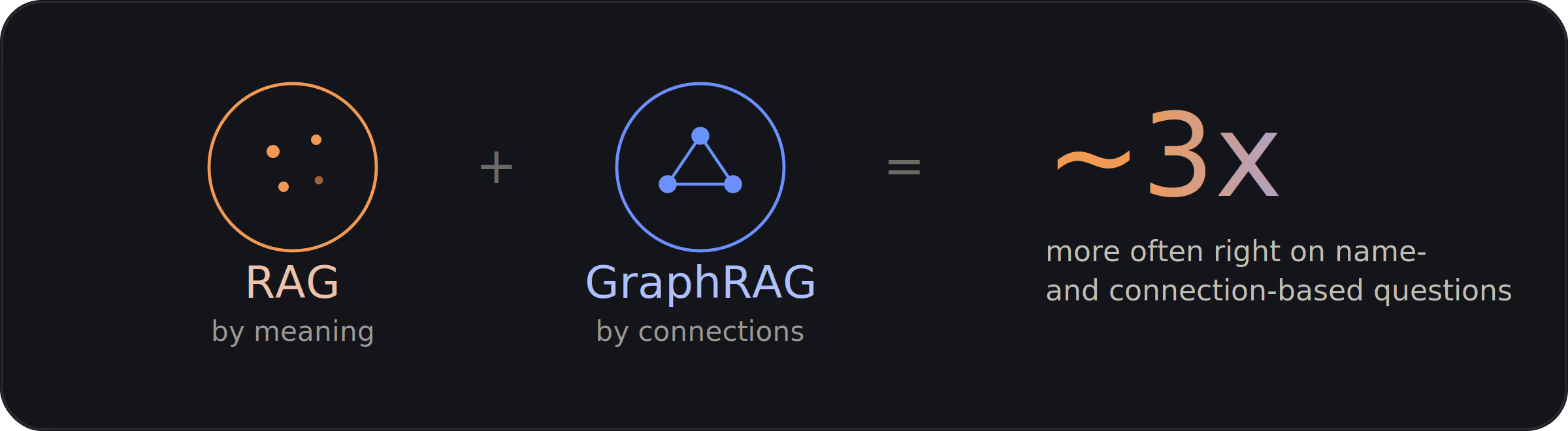
In internal testing on production-scale data rooms, combining semantic search with GraphRAG returned the correct passage roughly three times more often than semantic search alone for name- and connection-based questions.
Frequently asked questions
What does GraphRAG stand for?
GraphRAG stands for graph-based retrieval-augmented generation. It's an AI search method that answers questions by following the mapped relationships among facts, rather than relying solely on keyword- or meaning-based matching. GraphRAG first builds a graph of your knowledge and navigates the relationships within it.
How is GraphRAG different from RAG?
Traditional RAG matches your question to documents based on similar meaning and requires semantic overlap. GraphRAG instead follows logical connections between entities, so it can answer questions even when the wording and meaning don't line up. GraphRAG uses logical relationships, so you no longer need that overlap.
Is GraphRAG always better than other search methods?
No. Each method is a different tool for a different job. Sometimes keyword search is enough; sometimes semantic search wins — which is why the strongest systems, including Blueflame AI, use a hybrid of all of them.
Why is GraphRAG hard to build?
Building a graph you can trust requires deep domain expertise to know which entities and relationships matter and how to verify quality, and it requires all your data to be centralized and processed up front.
What is "multi-hop" reasoning?
Multi-hop reasoning is answering a question that requires chaining several connected facts together — like finding one person, then something linked to them, then something linked to that. GraphRAG handles this by hopping from node to node along the graph.
Better data retrieval leads to better deal decisions
You don't need to be an AI engineer to understand why GraphRAG matters.
At its core, it's about helping AI retrieve information the same way investment professionals think: by connecting people, companies, transactions, and events — not just matching words on a page.
As investment banking, private equity, and private creditfirms increasingly rely on AI, the quality of the answers they receive will depend on more than the model itself. It will depend on how effectively the platform retrieves, connects, and reasons over information.
That's why Blueflame AI combines multiple retrieval strategies into a single purpose-built platform designed for complex financial workflows.