

Generative AI has made remarkable progress, but financial workflows continue to expose its limits.
Searching thousands of documents, extracting metrics from complex spreadsheets, and producing consistent results across changing foundation models require more than a capable LLM — they require an AI platform purpose-built for the way financial institutions work.
We sat down with Blueflame AI's Head of Data Science, Christopher Redino, to discuss how the team approaches these challenges through model orchestration, domain-specific benchmarking, purpose-built retrieval, and a platform designed to improve over time.
Q. Why use Blueflame AI instead of just using an LLM or general-purpose AI?
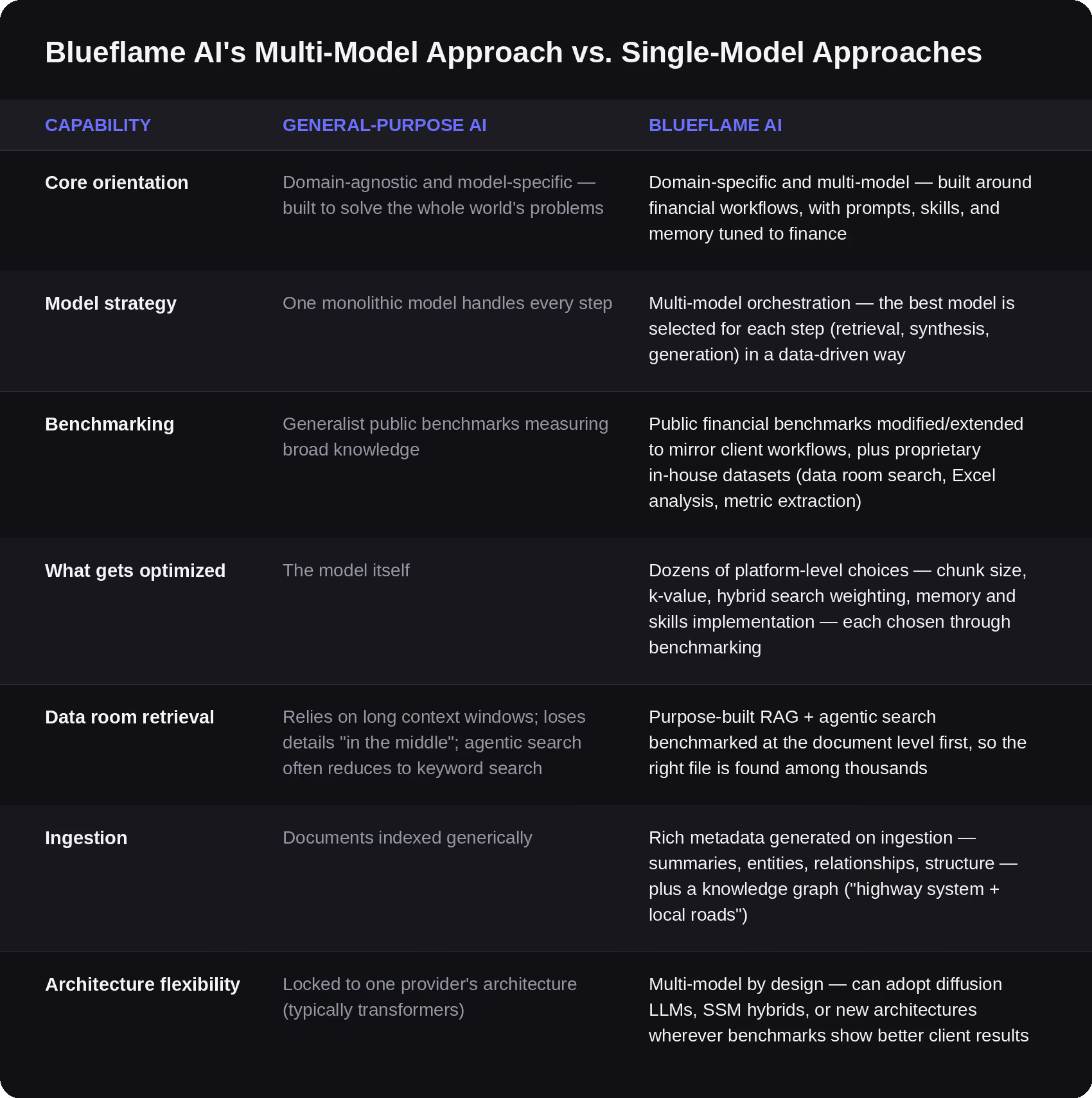
Christopher Redino: Foundation labs are domain-agnostic and model-specific. Blueflame AI is the opposite: domain-specific and model-agnostic. General-purpose AI’s goal is to solve the whole world's problems. Blueflame is focused on the challenges of our clients, and that means prompts, skills, and memory tuned to finance.
We design the system from the ground up around specific financial workflows and continuously optimize it.
Q. At Blueflame AI, we say no single model wins every task. What does that mean in practice?
Christopher Redino: There's a lot of talk about "model routing" solving the problems of expensive, monolithic models. We prefer the term model orchestration because it's rarely a simple call-and-response. It's a workflow — retrieval, synthesis, generation — and the best model for each step can be different.
We decide which LLM handles which step in a data-driven way, using our own benchmarks: some are curated public benchmarks we've modified, while others are fully in-house. "Best" doesn't only mean the most accurate.
As we build out our AI harness, retrieval-augmented generation (RAG) system, and the rest of the platform, model performance often converges — which means we can pick the cheaper, lower-latency model without sacrificing accuracy, and keep results consistent even when we switch models, cutting down on switching friction.
Q. Public AI benchmarks are useful, but why aren't they enough for Blueflame's users?
Christopher Redino: Generalist AI benchmarks test a broad range of things. However, general knowledge isn't the same as being effective at a specific task in a specific domain.
While we do use public financial benchmarks, they’re just a starting point. We later modify and extend them to mirror our clients' workflows and simulate real user behavior.
We supplement heavily with proprietary, in-house datasets built around what our clients actually need: data room search, Excel analysis, metric extraction, and more.
Q. When Blueflame AI benchmarks performance, what are you measuring beyond the foundation model itself?
Christopher Redino: Benchmarks aren't just for picking one model over another, though that alone is useful. Building a platform means dozens of smaller choices layered on top: chunk size when embedding, the k-value for how much to retrieve before generating, whether to run hybrid search and how much weight to give keywords, how memory and skills get implemented, etc.
None of these has one clean, obvious answer; there are many ways to build each piece, and we make every one of those choices through a data-driven approach.
Q. Data room analysis is one of the hardest places for AI to perform well. How does Blueflame AI benchmark retrieval across large VDRs?
Christopher Redino: Search inside a virtual data room underlies most of what we do at Blueflame AI, and it's genuinely hard. A VDR can hold thousands of files, from dense spreadsheets to hundred-page PDFs full of tables and diagrams.
Even with a long context window, a lot of that is noise to parse through, and models still lose details in the middle. Our approach starts simple: benchmark retrieval at the document level first.
Our theory is that finding the right document among thousands is the hardest part — get that right, and the rest follows. We built our own dataset using real, consented client data and wrote a range of challenging questions against it.
Existing RAG systems and agentic search couldn't handle the full set. That gap is what pushed Blueflame to build our own methodology.
Q. Why does Blueflame AI's combination of RAG and agentic search outperform a general-purpose AI model in large data rooms?
Christopher Redino: This is really what we mean by purpose-built. It starts at [data] ingestion, where we generate a wide range of metadata — summaries, entities, relationships, and structure. These aren't shots in the dark; we extract what we already know from understanding the domain that we'll need later. That metadata gets oriented and made available for whatever comes next.
Think of it as a map of the data room. The summaries act like a highway system; they get you to the right neighborhood fast. The knowledge graph we build is the set of local roads that gets you the rest of the way to the exact answer. And while strong, RAG is still just one strategy.
When we need to go beyond RAG, agentic search is less of a replacement and more like a power user of the full platform that has RAG as one of its tools.
Q. What are diffusion LLMs and SSM hybrids, and how do they differ from transformers?
Christopher Redino: Transformers dominate AI today, but they won't necessarily be the architecture that dominates forever. New approaches are constantly emerging from academia before eventually making their way into commercial products.
Two examples are diffusion LLMs and state-space model (SSM) hybrids. Both are designed to address a common weakness in today's transformer models: the "lost in the middle" problem, where important details buried in long documents or conversations can be overlooked or distorted.
Diffusion LLMs take inspiration from image generation models. Instead of building a response one word at a time, they work toward the answer as a whole. That can make it easier to preserve context across long documents, though it comes with its own trade-offs.
SSM hybrids take a different approach. Rather than focusing primarily on the most recent text, they maintain a representation of the broader conversation, giving them a stronger sense of long-term context. In many ways, they're revisiting ideas from earlier architectures like long short-term memory (LSTM) networks, but with modern techniques that overcome many of the scalability challenges those systems faced.
Neither architecture is mainstream today. Some commercial and open-source models exist, but they're still early. That's why being model-agnostic matters.
As new architectures prove themselves — whether they come from frontier labs, academia, or our own research — we can adopt them wherever Blueflame AI benchmarks show they deliver better results for our clients.
Q. Why is Blueflame's approach to agent design moving toward graph-based flows?
Christopher Redino: Our long-running conversational agents — the kind you'd use across sessions, expecting them to remember you and your workflows — remain fairly traditional. However, we're building dedicated sub-agents for workflows that plan against an explicit graph structure instead.
Our clients’ workflows tend to be repeatable, even with real variance between them, which is why our Blueprints have already proven useful. We want to capture that repeatability explicitly in how agents plan.
For most agents, a plan is temporary — generated on the spot and discarded once the task finishes or rewritten entirely the moment something goes wrong. Making the graph a persistent, first-class object gives us transparency and auditability, plus smarter retries. We can go straight to the point of failure and retry from there, instead of starting over from scratch.
It also opens the door to online learning on these graphs, so workflows improve over time, with real reusability; the same workflow should work for a new client, deal, or vertical without extra setup; the agent will understand how to adapt it.
Q. What does it mean for Blueflame AI's workflows to compound over time, and why does that matter for financial institutions?
Christopher Redino: Financial institutions need AI that's reliable, consistent, and low-friction. The goal is to accelerate work, not add another tool that slows it down. Blueflame compounds in two ways.
The first is familiar: prompts, skills, memories, and metadata accumulate over time, allowing the system to better understand how you and your firm work. What isn't common is what happens when your model provider runs into availability, regulatory, or performance issues that force a switch. In most platforms, that accumulated context is more tightly coupled to the underlying model than people realize, making transitions disruptive.
Blueflame AI builds the same rich context, but the platform is model-agnostic by design. We benchmark specifically for consistency across models, so switching providers produces the same outputs. You get the benefits of compounding context without the vendor lock-in.
The second is our sub-agent graphs, which enable true online learning. Every workflow —across clients, verticals, and deals —makes the system better: better tool selection, better prompts, better parameters, and better decisions.
Even as conditions change, it learns how to adapt.
Q. General-purpose AI can search documents, too. What makes Blueflame AI's RAG with agentic search meaningfully better for financial workflows?
Christopher Redino: The challenge isn't just scale — it's that most real-world questions require both breadth and depth at the same time. Most systems struggle to do both. Agentic search alone often amounts to little more than keyword search, hoping each isolated document contains enough context to answer the question.
Blueflame AI solves this the same way across the whole platform, not just in search: by generating metadata — summaries, entities, relationships, structure — as documents come in, because our domain knowledge tells us ahead of time what we'll need later.
From there, it's about orchestration: retrieval, task decomposition, source validation, model selection, and iterative exploration, each tuned to the step in front of it. That combination — purpose-built ingestion plus the right model and the right tool at each stage — lets us build search strategies that simply aren't available in a general-purpose system.
The power of AI built for modern dealmaking
Foundation models will continue to evolve, but the real competitive advantage won't come from the model alone, but from the systems built around it.
Purpose-built metadata, model orchestration, rigorous benchmarking, and workflows that improve over time are what transform powerful foundation models into AI platforms like Blueflame that financial institutions can trust.
As Christopher Redino makes clear, building AI for finance isn't about chasing the latest model release. It's about engineering a platform that consistently delivers reliable results, adapts as the technology evolves, and understands the complexity of real financial workflows.